The growth of digital services has propelled electricity demand to levels that strain existing power infrastructure. Cloud computing, streaming platforms, artificial intelligence research, and machine learning systems all require huge amounts of continuous electrical power. Conventional electricity grids often struggle to provide that power reliably without significant upgrades. Renewable sources such as wind and solar help reduce carbon emissions, yet they cannot provide uninterrupted baseload power without storage support. As a result, a growing number of energy planners and technology companies are exploring advanced nuclear technologies as potential solutions.
Among the nuclear innovations gaining attention are micro‑nuclear reactors and small modular reactors (SMRs). These classes of nuclear systems are much smaller and more flexible than traditional nuclear plants. Their designs aim to deliver low‑carbon, reliable power in distributed locations, including sites close to or within data center campuses.
This article explains what microreactors and SMRs are, why data centers are considering them, the major players developing these systems, the technical and regulatory challenges involved, and how they might influence the future of data center energy supply.
What Are Micro‑Nuclear Reactors and SMRs
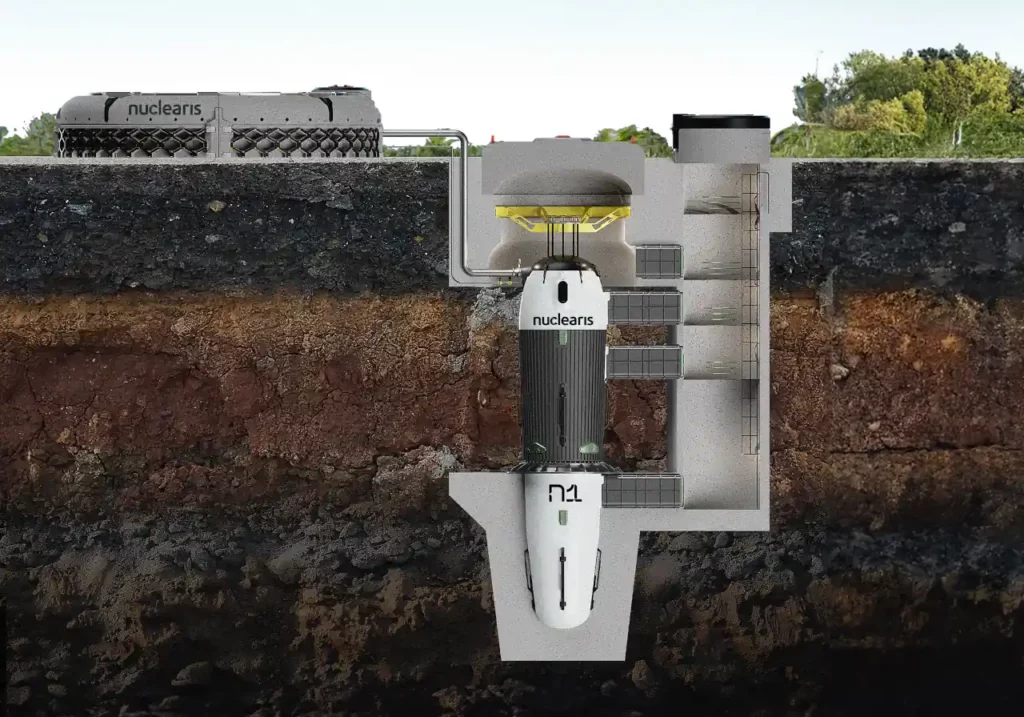
Micro‑nuclear reactors are compact nuclear fission systems designed to generate a relatively small amount of electricity, often less than 20 megawatts electric. They are significantly smaller than conventional nuclear power plants, which typically produce hundreds or thousands of megawatts. These reactors are designed for transportable deployment by truck, rail, or air and can operate independently of centralized electricity grids or as part of a microgrid. Their compact scale and modular construction reduce site requirements, making them suitable for locations such as industrial parks, remote facilities, or data center campuses.
Small modular reactors fall into a broader category of advanced nuclear technology that aims to produce up to approximately 300 megawatts electric. SMRs leverage factory fabrication and standardized designs to shorten construction timelines and reduce cost relative to large nuclear plants. While microreactors emphasize portability and local generation, SMRs focus on modularity at slightly larger scales.
Both microreactors and SMRs aim to provide low‑carbon, reliable baseload power with reduced construction risk. They are part of a larger nuclear innovation movement that seeks to make nuclear power more flexible, cost‑effective, and accessible than traditional large plants.
Why Data Centers Are Exploring Nuclear Power
Modern data centers, especially those supporting artificial intelligence workloads, require vast amounts of electricity. Concrete estimates indicate that global data center electricity consumption could exceed 1,000 terawatt‑hours annually by 2030 as demand for AI and compute‑intensive operations rises. At the same time, data center sites in key regions such as Northern Virginia, Phoenix, Dublin, and Singapore have experienced grid congestion and interconnection delays that complicate plans for expansion.
Renewable energy paired with battery storage helps reduce carbon emissions but does not always meet the continuous power requirements of large compute clusters. Nuclear power’s unique characteristics — specifically low carbon emissions and consistent output — make it an attractive complement to renewables. Nuclear generation can provide 24/7 baseload power that supports both operational reliability and corporate sustainability goals.
In recent years, major data center operators have begun to explore nuclear solutions. For example, Equinix, a global data center company, entered into advanced nuclear energy agreements designed to help supply power to its facilities. These long‑term strategies include power purchase agreements for SMRs and preorder agreements for microreactors, illustrating a broad industry interest in nuclear alternatives to grid dependence.
Key Projects and Companies
NANO Nuclear and the KRONOS Micro Modular Reactor
NANO Nuclear Energy Inc. is one of the companies developing advanced nuclear technology. The company’s KRONOS Micro Modular Reactor (MMR) is a compact system designed to produce about 15 megawatts of electrical output, roughly equivalent to 45 megawatts of thermal generation. KRONOS uses high‑temperature gas cooling and TRISO (tri‑structural isotropic) fuel, which provides stable containment and passive safety characteristics.
The KRONOS MMR was created through a rebranding of a previously acquired microreactor technology. The reactor is being advanced through regulatory engagement and demonstration planning. NANO Nuclear has partnered on strategic tasks such as engineering, environmental analysis, and regulatory pathway planning at the University of Illinois Urbana‑Champaign. This collaboration supports licensing work with the U.S. Nuclear Regulatory Commission and paves the way for future demonstration facilities.
In addition to KRONOS, NANO Nuclear’s broader portfolio includes other advanced reactor designs, such as portable solid‑core microreactors and low‑pressure coolant systems. These technologies aim to provide a range of flexible nuclear power solutions for different energy needs.
Oklo and the Aurora Reactor
Oklo is a California‑based nuclear startup supported by technology investors and focused on advanced small modular reactors. The company’s Aurora reactor was scaled to produce up to 75 megawatts of electrical capacity to better align with large customer demands, including those from data center operators. Companies in the data center sector have signed supply agreements with Oklo for hundreds of megawatts of nuclear power capacity, and Oklo maintains a growing pipeline of potential partners.
Oklo’s reactor design uses metallic fuel that can operate on high‑assay low enriched uranium or used nuclear fuel. In addition to electrical generation, the reactor’s thermal output can support industrial heat applications. Oklo has also entered into partnerships that integrate nuclear power with cooling systems for AI and high‑performance data centers, potentially enhancing overall energy efficiency.
The company has advanced through regulatory preparation processes and plans to bring its first reactors online at demonstration sites in the late 2020s. Deployment at scale depends on regulatory review and licensing approvals.
Other Industry Initiatives
Equinix expanded its advanced nuclear commitments by signing agreements with multiple developers to secure future power. These initiatives include preorder agreements for 20 microreactors from Radiant Nuclear, a startup developing transportable microreactor designs that can deliver on‑site power quickly once approved. Equinix also signed longer‑term power purchase intentions with other reactor developers, including SMRs and more traditional modular nuclear plants, to diversify its future energy portfolio.
Internationally, tech companies are also exploring nuclear power. For example, Google signed a partnership with a nuclear developer to procure up to 500 megawatts of generation capacity from small modular reactors by around 2030. This would supply low‑carbon power and help meet the energy demands of large AI data center operations.
These collaborations demonstrate a broader industry trend toward nuclear energy as part of long‑term energy planning for data centers and other digital infrastructure.
Opportunities and Challenges
Advanced nuclear technologies offer several advantages for data center energy strategy. They can improve reliability in regions where grid capacity is constrained and provide low‑carbon power that supports corporate sustainability goals. Microreactors, in particular, can be located close to end users, reducing dependency on long transmission lines and large grid upgrades.
Many designs also aim for long operational cycles without refueling, potentially running continuously for several years before maintenance. This reduces operational disruption and helps ensure consistent power supply.
However, significant challenges remain before these technologies are widely deployed. Regulatory licensing for nuclear systems is rigorous and time consuming, requiring detailed safety reviews, environmental analysis, and community engagement. Manufacturing and supply chains must scale for commercial deployment, and capital costs remain high until modular production and standardized designs become more mature.
Public perception and policy environments also influence how fast and where nuclear projects can be built. Developers must navigate complex stakeholder landscapes, including local communities, national regulators, and environmental advocates.
Integration with existing infrastructure is another consideration. Nuclear generation systems must be coordinated with grid operators or microgrid systems, which requires planning and sometimes additional investment in transmission and distribution capacity.
The Future of Nuclear Power and Data Centers
Interest in microreactors and small modular reactors reflects a broader reassessment of how reliable, low‑carbon energy is supplied to critical digital infrastructure. While commercial deployment of these technologies is still emerging, exploratory agreements between tech companies and nuclear developers highlight the role the industry sees for nuclear power in future energy mixes.
Industry analysts project that the first commercial microreactors and SMRs could come online in the late 2020s and early 2030s, depending on regulatory progress and capital deployment. Successful demonstration projects will serve as important proof points for the viability of nuclear power in distributed energy applications, including data centers.
For data center operators, advanced nuclear power is one of several tools for building resilient, low‑carbon energy systems. When paired with renewable generation and energy storage, nuclear technologies could help campuses and clusters of facilities meet sustainability goals while ensuring the constant power supply needed for high‑performance computing.
References
NANO Nuclear Energy Inc announces KRONOS MMR as the new tradename for its micro modular reactor energy system. https://ir.nanonuclearenergy.com/news-releases/news-release-details/nano-nuclear-energy-announces-kronos-mmr-new-tradename-its/
NANO Nuclear engages AECOM for microreactor project at University of Illinois Urbana‑Champaign. https://www.investing.com/news/company-news/nano-nuclear-energy-inc-partners-aecom-advance-kronos-mmrtm-microreactor-development-at-university-of-illinois-urbana-champaign‑4292526
NANO Nuclear acquires Illinois facility for KRONOS microreactor development. https://www.stocktitan.net/news/NNE/nano-nuclear-acquires-23-537-square-foot-demonstration-and-office-3sxobcz06urh.html
NANO Nuclear secures a US Air Force contract for its microreactor development. https://www.investing.com/news/company-news/nano-nuclear-secures-125-million-air-force-contract-for-microreactor‑93CH-4231713
Equinix enters into multiple advanced nuclear deals to power data centers (Reuters). https://www.investing.com/news/stock-market-news/equinix-enters-into-multiple-advanced-nuclear-deals-to-power-data-centers‑4192106
Equinix signs three major deals with advanced nuclear firms for more than 750MW of power. https://www.datacenterdynamics.com/en/news/equinix-signs-three-major-deals-with-advanced-nuclear-firms-for-more-than-750mw-of-power/
Oklo boosts Aurora reactor capacity to 75MW to power AI data centers. https://www.datacenterdynamics.com/en/news/oklo-boosts-aurora-reactor-capacity-to-75mw-to-power-ai-data-centers/
Oklo and Vertiv team up to develop nuclear power and cooling systems for data centers. https://www.investopedia.com/oklo-and-vertiv-team-up-to-take-advantage-of-ai-boom-11776542
Google set to power its AI data centers with small modular reactors. https://www.euronews.com/business/2024/10/15/google-set-to-power-its-ai-data-centres-with-mini-nuclear-reactors
Information on Kairos Power, small modular reactor developer. https://en.wikipedia.org/wiki/Kairos_Power
Microreactors and SMRs overview. https://en.wikipedia.org/wiki/Nuclear_microreactor