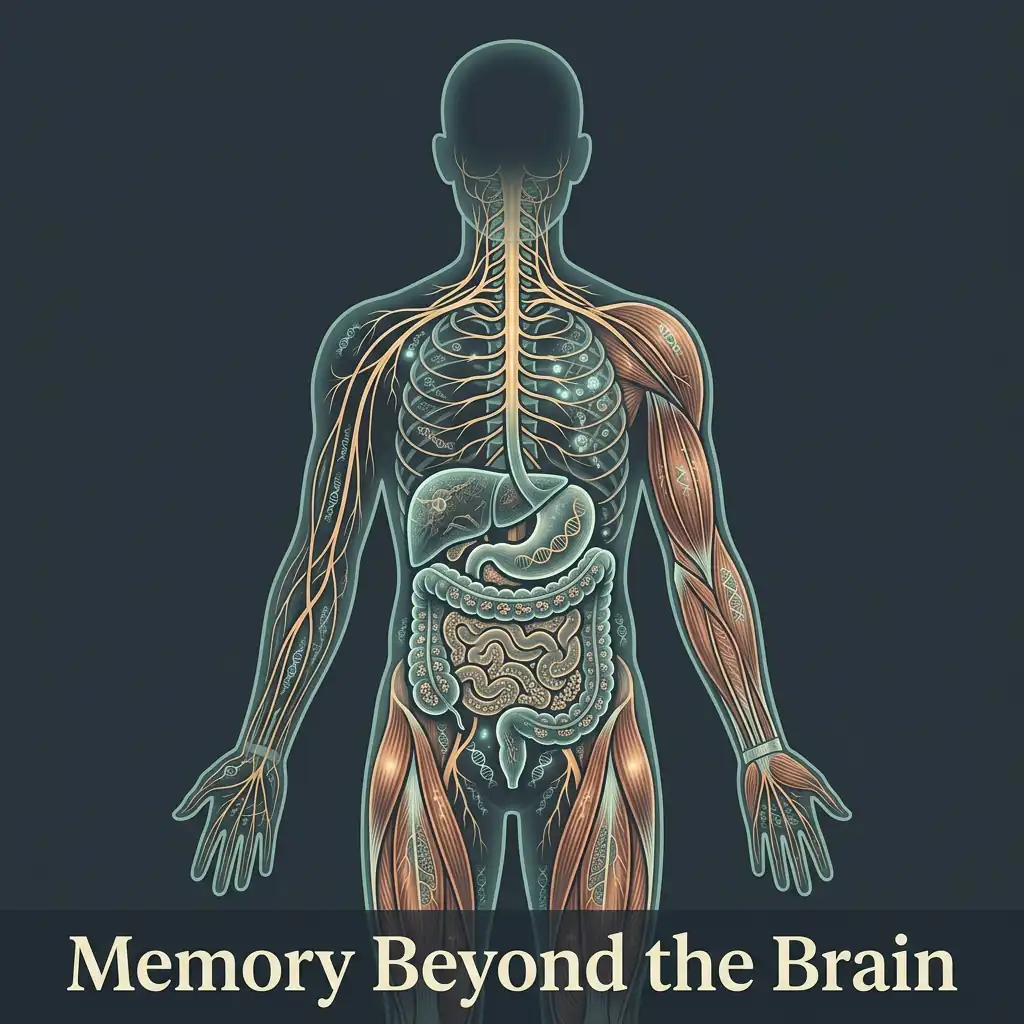
Introduction: Expanding the Boundaries of Memory
For much of modern scientific history, memory has been treated as a function rooted firmly in the brain. The dominant view has focused on neurons, synapses, and electrochemical signaling as the basis for how experiences are encoded, stored, and later retrieved. This framework has yielded powerful insights. Researchers have mapped memory-related brain regions, identified mechanisms behind learning, and even manipulated specific memories in controlled experiments.
Yet over the past few decades, this understanding has begun to evolve. A growing body of research across neuroscience, molecular biology, immunology, and systems biology suggests that memory is not confined to a single organ or mechanism. Instead, it appears to emerge from multiple layers of biological organization, each contributing in distinct but interconnected ways.
This shift does not support the idea that memory exists independently of the body or floats outside physical systems. Rather, it points to a more complex and grounded reality. Memory is increasingly understood as a distributed property of living systems, one that operates across neural networks, cellular processes, and even interactions between different organs.
Understanding this broader view requires moving beyond the traditional brain-centric model without abandoning it. The brain remains essential for conscious and experiential memory. However, it is no longer the only place where meaningful forms of memory-like processes occur.
The Foundations: Memory in the Brain
The classical model of memory is built on the concept of synaptic plasticity. This refers to the ability of connections between neurons to strengthen or weaken based on experience. These changes allow the brain to encode information, stabilize it over time, and retrieve it when needed.
Memory formation is often described in three stages. Encoding transforms sensory input into neural activity. Consolidation stabilizes that activity through structural and biochemical changes. Retrieval reactivates the stored patterns, allowing past experiences to influence present behavior.
Within this framework, certain brain structures play key roles. The hippocampus is essential for forming new memories, particularly those related to events and experiences. Over time, these memories are distributed across the cortex, where they are stored more permanently.
Research has identified clusters of neurons known as engrams, which represent specific memories. These engrams are not isolated units but parts of larger networks. When they are activated, the associated memory is recalled. When they are disrupted, the memory can become inaccessible.
Even in this well-established model, memory is not localized in a single spot. It exists as a pattern distributed across networks of neurons. This observation has been one of the first clues that memory might be more widespread than originally thought.
Memory at the Molecular Level
One of the most important developments in recent research is the recognition that memory extends beyond synaptic connections into the internal machinery of cells.
Neurons do not simply communicate through electrical signals. They also undergo lasting biochemical changes. These changes involve gene expression, protein synthesis, and structural modifications within the cell. In many cases, these molecular processes are necessary for long-term memory formation.
Epigenetics plays a central role here. Epigenetic mechanisms regulate how genes are turned on or off without altering the underlying DNA sequence. These include processes such as DNA methylation and histone modification. Through these mechanisms, cells can maintain a record of past activity.
In the context of memory, epigenetic changes help stabilize learning over long periods. They act as a kind of internal memory system within each cell, allowing it to respond differently based on prior experiences.
Importantly, these processes are not limited to neurons. Cells throughout the body use similar mechanisms to adapt to changing conditions. This suggests that the capacity to store information about the past is a fundamental property of living systems, not just a feature of the nervous system.
Memory as a Dynamic Network
Modern neuroscience increasingly views memory as a dynamic and distributed process rather than a static storage system.
When a memory is formed, it is encoded across multiple brain regions simultaneously. These regions may include areas responsible for sensory processing, emotion, and decision-making. The memory is not stored in any single location but exists as a coordinated pattern of activity across this network.
When the memory is recalled, the pattern is reactivated. This process is not perfect. Each act of recall can modify the memory, making it more of a reconstruction than a replay. This is why memories can change over time, becoming distorted or blended with other experiences.
Sleep plays a crucial role in stabilizing these patterns. During certain stages of sleep, the brain replays recent experiences. This replay strengthens connections between neurons and helps integrate new information with existing knowledge.
This perspective highlights an important point. Memory is not a fixed object stored somewhere in the brain. It is an ongoing process that is continuously updated and reshaped.
Biological Memory Beyond the Brain
While conscious memory is closely tied to the brain, other systems in the body exhibit forms of memory that operate on different principles.
The immune system provides one of the clearest examples. When the body encounters a pathogen, it mounts a response that includes the creation of specialized cells capable of recognizing that pathogen in the future. These cells persist, allowing for faster and more effective responses upon re-exposure.
This process, known as immunological memory, does not involve thoughts or experiences. However, it fulfills the core function of memory by storing information about past events and using it to guide future responses.
Another example is the enteric nervous system, often referred to as the gut’s nervous system. This system contains millions of neurons and can operate independently of the brain in many cases. It regulates digestion and can adapt its behavior based on previous activity.
The heart also contains networks of neurons and communicates extensively with the brain. It can adjust its behavior based on prior physiological states, particularly in relation to stress and emotional responses. However, there is no evidence that it stores personal memories or experiences.
These systems demonstrate that memory-like processes are not confined to the brain. Instead, they are distributed across different biological systems, each serving specific functions.
Cellular Memory in Non-Neural Systems
Beyond specialized systems like the immune system, even ordinary cells exhibit forms of memory.
Cells can respond differently to stimuli based on their history. For example, a cell exposed to stress may activate protective mechanisms that make it more resilient to future stress. These changes can persist over time, influencing how the cell behaves.
This type of memory is encoded through biochemical pathways and gene regulation. It does not involve consciousness, but it allows the cell to adapt based on past experiences.
Such findings suggest that memory is not an exclusive feature of complex organisms. Instead, it is a general property of life, present even at the level of individual cells.
The Microbiome and Biological History
The human body is home to trillions of microorganisms, particularly in the gut. These microbial communities change over time in response to diet, environment, and internal conditions.
As they evolve, they retain patterns shaped by past interactions. These patterns influence how the microbiome functions, affecting digestion, immune responses, and even aspects of behavior.
Communication between the gut and the brain occurs through multiple pathways, including neural, hormonal, and immune signaling. This interaction is often referred to as the gut-brain axis.
While the microbiome does not store memories in the cognitive sense, it represents a form of biological history embedded within a complex system. It reflects past experiences and influences future outcomes.
Technological Extensions of Memory
Advances in neuroscience and engineering have begun to extend memory beyond biological systems.
One area of research focuses on memory prosthetics. These devices aim to replicate the activity of brain regions involved in memory formation. In experimental settings, they have been used to restore certain memory functions in animals and, in some cases, humans.
Another area involves brain decoding. By combining neural imaging with machine learning, researchers can reconstruct aspects of perception or thought from patterns of brain activity. This does not mean that memories are stored outside the brain, but it shows that they can be represented externally.
There have also been early experiments in brain-to-brain communication. These studies have demonstrated that simple signals can be transmitted between individuals using technological interfaces. While far from transferring memories, they suggest that direct neural communication is possible at a basic level.
These developments indicate that memory processes can be partially externalized, though they remain dependent on physical systems.
Collective and Distributed Memory Systems
Memory is not limited to individual organisms. It can also exist at the level of groups and systems.
In human societies, knowledge is distributed across individuals and stored in cultural and technological systems. Books, digital media, and institutions all serve as repositories of information.
In biological systems, populations of cells can collectively encode information about past events. This collective behavior allows the system to respond more effectively to future challenges.
In these cases, memory is not located in a single entity. It emerges from interactions between multiple components. This form of memory is shared in a functional sense, even though it does not involve shared subjective experience.
Current Limits and Misinterpretations
As the concept of memory expands, it is important to distinguish between scientifically supported ideas and speculative claims.
There is no reliable evidence that personal memories exist independently of physical systems. Memory, in all known cases, depends on material processes, whether in neurons, cells, or technological devices.
There is also no evidence that memories can be directly shared between individuals without a physical mechanism. While communication can transmit information, it does not transfer experiences in a literal sense.
Claims that memory exists outside the body in a non-physical form fall outside mainstream science. Current research consistently supports the view that memory is grounded in physical systems.
Toward a Multi-Scale Understanding of Memory
The emerging scientific perspective is that memory operates across multiple levels of organization.
At the neural level, it involves synaptic plasticity and network dynamics. At the cellular level, it involves gene expression and biochemical signaling. At the system level, it involves interactions between different organs and biological processes.
Technological systems add another layer, allowing memory to be recorded, manipulated, and extended beyond the biological body.
Across all these levels, memory can be understood as the capacity of a system to encode past interactions and use them to guide future behavior. This definition applies broadly, from individual cells to complex organisms and even artificial systems.
Conclusion: A Broader but Grounded Perspective
The idea that memory extends beyond the brain is not entirely incorrect, but it requires careful interpretation.
Scientific research shows that memory is not confined to a single structure. It is distributed across multiple systems and implemented through a variety of physical mechanisms. At the same time, it remains firmly grounded in the material world.
There is no evidence that memory exists independently of physical processes or that it can be freely shared without a supporting system.
The most accurate understanding is that memory is a distributed and dynamic property of complex systems. It spans neurons, cells, bodies, and increasingly, machines. Rather than being located in one place, it emerges from the interactions that define living systems.
References
Kandel, E. R., Dudai, Y., & Mayford, M. R. (2014). The molecular and systems biology of memory. Cell, 157(1), 163–186.
Josselyn, S. A., & Tonegawa, S. (2020). Memory engrams: Recalling the past and imagining the future. Science, 367(6473).
Levenson, J. M., & Sweatt, J. D. (2005). Epigenetic mechanisms in memory formation. Nature Reviews Neuroscience, 6(2), 108–118.
Alberini, C. M., & Kandel, E. R. (2015). The regulation of transcription in memory consolidation. Cold Spring Harbor Perspectives in Biology, 7(1).
Netea, M. G., et al. (2016). Trained immunity: A program of innate immune memory. Science, 352(6284).
Cryan, J. F., & Dinan, T. G. (2012). Mind-altering microorganisms: The impact of the gut microbiota on brain and behavior. Nature Reviews Neuroscience, 13(10), 701–712.
Fuster, J. M. (2015). The Prefrontal Cortex (5th ed.). Academic Press.
Nicolelis, M. A. L. (2011). Beyond Boundaries: The New Neuroscience of Connecting Brains with Machines. Times Books.
Berger, T. W., et al. (2011). A hippocampal cognitive prosthesis: Multi-input, multi-output nonlinear modeling and VLSI implementation. IEEE Transactions on Neural Systems and Rehabilitation Engineering, 19(2), 198–211.
Fields, R. D. (2008). White matter in learning, cognition and psychiatric disorders. Trends in Neurosciences, 31(7), 361–370.
Dudai, Y. (2012). The restless engram: Consolidations never end. Annual Review of Neuroscience, 35, 227–247.
Buzsáki, G. (2019). The Brain from Inside Out. Oxford University Press.
Sweatt, J. D. (2016). Neural plasticity and behavior: Sixty years of conceptual advances. Journal of Neurochemistry, 139(S2), 179–199.
Smolen, P., Baxter, D. A., & Byrne, J. H. (2016). Molecular constraints on synaptic tagging and maintenance of long-term potentiation. Progress in Brain Research, 229, 1–30.
Tonegawa, S., Morrissey, M. D., & Kitamura, T. (2018). The role of engram cells in the systems consolidation of memory. Nature Reviews Neuroscience, 19(8), 485–498.