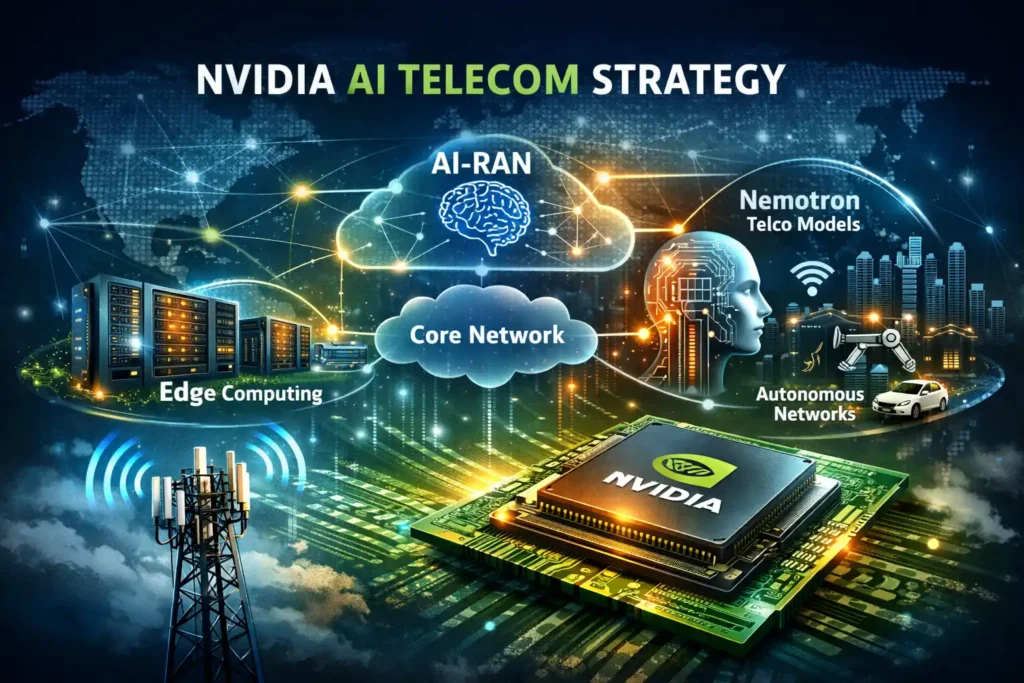
For decades, telecom networks have been built as systems that move data efficiently from one point to another. Most of the intelligence has traditionally lived outside the network, in centralized data centers. What NVIDIA is proposing marks a shift away from that model. The company is pushing toward a network that does more than transport data, one that can process, interpret, and respond to it in real time.
This direction is already taking shape through recent announcements around AI-native radio networks, telecom-specific AI models, and deployment frameworks designed for operators. Seen together, these efforts point to something broader than incremental upgrades. NVIDIA is positioning telecom infrastructure as part of the AI compute layer itself.
A Network That Processes Data, Not Just Moves It
The underlying idea is straightforward. As AI workloads expand, sending everything back to centralized data centers becomes inefficient. Latency increases, bandwidth becomes a constraint, and costs rise. Telecom networks, with their distributed architecture and proximity to users, offer an alternative.
In this model, compute capabilities are pushed closer to where data is generated. Parts of the radio access network, edge nodes, and core systems begin to handle AI workloads directly. The network gains the ability to analyze traffic conditions, anticipate congestion, and adjust behavior dynamically.
This is often described as AI-RAN, but the term only captures part of the shift. The more important change is structural. The same infrastructure that carries data begins to participate in processing it. That opens the door to new uses, from real-time optimization to edge-based AI services.
Building an Ecosystem Around AI-Native Telecom
NVIDIA is not approaching this as a standalone effort. It has been working with operators, telecom vendors, and infrastructure partners to define a shared direction for AI-native networks. The focus is on open architectures that can support future 6G systems while remaining compatible with existing deployments.
This collaborative approach addresses a long-standing constraint in telecom. The industry evolves slowly, partly because it depends on coordination across many players. By aligning vendors and operators around a common framework, NVIDIA is trying to accelerate that process.
The technical direction is becoming clearer. Networks are increasingly software-defined, hardware is abstracted where possible, and GPU-based acceleration is introduced into environments that were not originally designed for it. AI is treated as a core capability rather than an add-on.
Nemotron and Telecom-Specific AI Models
A central piece of this strategy is the development of Nemotron-based models adapted to telecom environments. These systems are designed to work with the types of data and constraints that define network operations.
Telecom networks produce continuous streams of operational data and rely on complex rule sets. Traditional automation handles this through predefined scripts and thresholds, which can be rigid when conditions change. The newer models aim to handle variability more effectively.
They can interpret network states, identify irregular patterns, and suggest or execute responses. Instead of following fixed instructions, they evaluate context and adjust actions accordingly. This makes them closer to decision systems than conventional automation tools.
In practice, this could reduce the need for manual intervention in routine operations. Engineers remain involved, but their role shifts toward oversight and system tuning rather than direct control of every process.
Turning Concepts into Deployable Systems
One of the practical challenges in telecom is moving from prototypes to production. Systems are complex, tightly integrated, and sensitive to disruption. Introducing AI into that environment requires careful integration.
To address this, NVIDIA has introduced operator blueprints. These are structured deployment frameworks that outline how AI models and agents can be integrated into existing workflows. They cover how data flows through the system, how decisions are validated, and how actions are executed.
The emphasis is on adaptability. Each operator has its own infrastructure and constraints, so the models need to be trained and adjusted using local data. The blueprints provide a starting point without imposing a fixed implementation.
This approach is intended to reduce the gap between experimentation and operational use. Instead of isolated trials, operators can begin to integrate AI into core functions such as network optimization and fault management.
Toward More Autonomous Networks
The direction of travel is clear. Networks are expected to handle more tasks on their own, from configuration to optimization and fault response. AI makes this progression more feasible by enabling systems to react to changing conditions without relying entirely on predefined rules.
This has implications for both performance and cost. Networks that can adapt in real time are better positioned to manage demand fluctuations and reduce inefficiencies. At the same time, automation can lower the operational burden.
The shift is gradual rather than immediate. Telecom infrastructure is not replaced overnight, and reliability requirements remain strict. Still, the trajectory points toward systems that require less direct intervention over time.
A Pragmatic Look at the Limits
The vision is ambitious, but there are practical constraints that are easy to overlook.
Telecom networks operate under strict reliability and regulatory requirements. Any system that introduces automated decision-making must meet high standards for predictability and auditability. AI models, especially those based on probabilistic reasoning, do not always behave in fully transparent ways. This can complicate deployment in critical infrastructure.
There is also the question of integration. Many operators run legacy systems that were not designed for GPU acceleration or AI-driven workflows. Upgrading or adapting these environments can be costly and time-consuming. The transition is unlikely to be uniform across regions or operators.
Another consideration is dependency. By embedding its hardware and software deeply into telecom infrastructure, NVIDIA strengthens its position in the stack. For operators, this can create efficiencies, but it also raises questions about vendor concentration and long-term flexibility.
Finally, the business case is still evolving. While AI-driven optimization can reduce costs and enable new services, the return on investment depends on how effectively these capabilities are deployed and monetized. Not all operators will see the same benefits at the same pace.
A Structural Shift in Progress
What stands out in NVIDIA’s approach is the level of coordination between hardware, software, and system design. The company is not focusing on a single layer. It is shaping how those layers connect.
This reflects a broader change in how infrastructure is being built. Networks are no longer static systems designed for a single purpose. They are becoming adaptable environments that can support multiple workloads, including AI.
Whether this vision becomes standard across the industry will depend on execution as much as technology. Telecom has its own constraints and timelines. Still, the direction is clear enough. The boundary between networking and computing is starting to blur, and that shift is already underway.