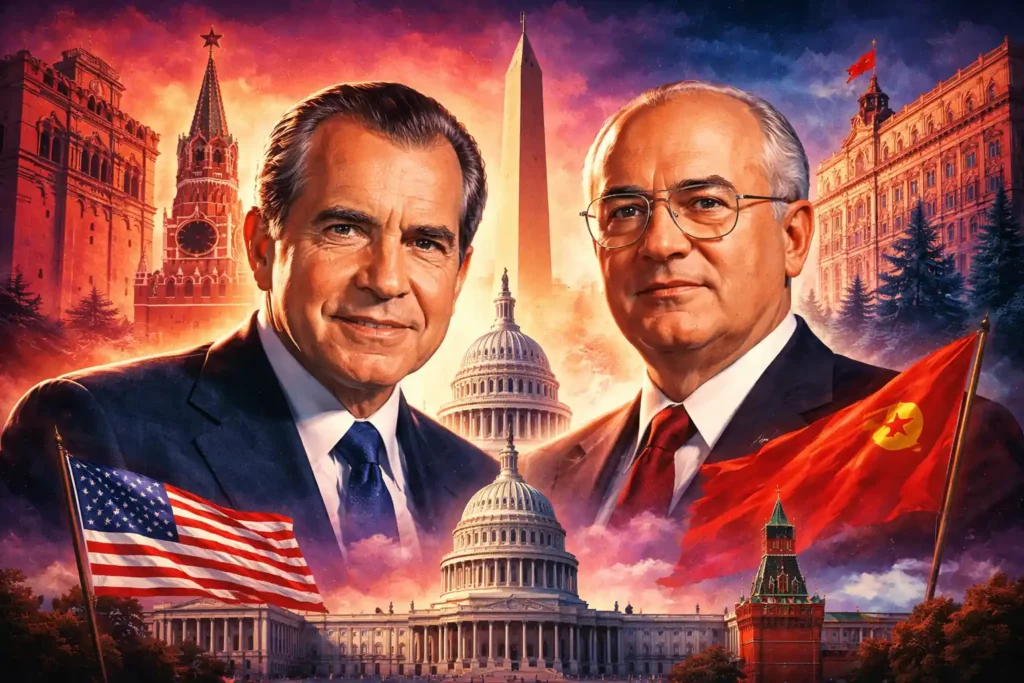
History often compresses complex endings into clean narratives. The Cold War is usually presented as a sequence that resolves once the right leaders emerge at the right time. In that version, Mikhail Gorbachev initiates reforms inside a rigid system, Ronald Reagan pivots from confrontation toward negotiation, and the Soviet Union gradually collapses under pressures that had been building for decades.
This interpretation is broadly supported by historical evidence. Yet it leaves out a more ambiguous layer that sits between formal decisions and final outcomes. That layer is shaped by timing, perception, and individuals operating outside official authority. One of those individuals is Richard Nixon, whose reappearance in the mid-1980s coincided with a period of deep uncertainty on both sides of the Cold War divide.
The goal here is not to overstate Nixon’s role. There is no credible evidence that he directed events or shaped outcomes in a decisive way. Instead, the focus is on correlation. His movements, access, and interpretations aligned in striking ways with a fragile geopolitical transition. Examining that alignment reveals something less obvious but still meaningful about how historical change unfolds.
The Return of a Discredited Figure
After the Watergate scandal, Nixon’s career appeared finished. His resignation in 1974 left him politically isolated, and his early attempts to re-enter public life were met with resistance. For several years, he remained largely on the margins.
What changed was not a sudden rehabilitation but a gradual shift in context. By the late 1970s and early 1980s, global politics had entered a more complex phase. The earlier period of détente had faded, tensions had risen again, and the strategic environment required experienced interpretation. In that setting, Nixon’s background in high-level diplomacy regained a certain relevance.
He returned first through writing and analysis. His books and essays focused on international strategy rather than domestic politics. Over time, he re-established quiet relationships with policymakers, diplomats, and foreign leaders. He did not regain formal power, but he regained access. That distinction is crucial.
Access allowed him to move more freely than active officials. He was not bound by protocol or institutional constraints. He could travel, meet leaders, and speak candidly without the same level of scrutiny. This flexibility would become increasingly significant as the decade progressed.
A Moment of Mutual Uncertainty
When Gorbachev rose to power in March 1985, neither the Soviet Union nor the United States fully understood the implications. The Soviet system had long shown signs of stagnation, but it had also proven resilient. Western intelligence assessments reflected this ambiguity. Some analysts saw potential for meaningful reform, while others remained skeptical.
Within the Reagan administration, views were also divided. There were factions that favored sustained pressure and others that saw an opportunity for engagement. Public rhetoric often emphasized confrontation, yet internal discussions were more nuanced.
It is in this context that Nixon’s renewed activity becomes notable. Around the same time, he increased his international travel and engagement. One detail often highlighted is his decision to give up Secret Service protection. While this can be interpreted in different ways, it clearly increased his flexibility. Without official security constraints, his movements were less structured and his interactions less formal.
This creates a first layer of correlation. A new Soviet leader introduces uncertainty into the system. The United States begins reassessing its position. Nixon increases his autonomy and re-enters the global stage with fewer constraints.
Private Meetings and the Flow of Interpretation
Nixon’s meetings with Gorbachev in the mid to late 1980s are well documented. These were substantive discussions rather than symbolic encounters. They provided Nixon with direct exposure to the thinking of the Soviet leadership.
What followed those meetings is just as important. Nixon returned to the United States and shared his impressions through briefings, interviews, and writings. He described Gorbachev as a serious and capable reformer, while also cautioning against excessive optimism.
This balanced framing had practical implications. It avoided both extremes of blind trust and rigid hostility. In a political environment where perception strongly influences policy, such framing helped create space for engagement without undermining caution.
At the same time, official institutions were producing their own assessments through intelligence and diplomatic channels. Nixon’s views did not replace these sources, but they added another layer. His credibility ensured that his interpretations were taken seriously within policy circles.
This is where the idea of a parallel channel becomes relevant. Nixon was not an official envoy, but he functioned as part of a broader flow of interpretation that connected Washington and Moscow.
Reykjavik and the Limits of Formal Diplomacy
The Reykjavík Summit illustrates both the potential and the constraints of official diplomacy. Reagan and Gorbachev came close to agreeing on sweeping nuclear reductions, including proposals that would have dramatically reshaped the strategic balance. The talks ultimately failed due to disagreements over missile defense.
The near breakthrough revealed how far both sides were willing to go. It also exposed the limits imposed by internal politics and institutional resistance. In the aftermath, interpretation became critical. Was Reykjavik a failure or a sign of deeper possibilities?
Nixon’s response leaned toward cautious optimism. He acknowledged the risks but emphasized the significance of the engagement itself. This type of framing does not directly alter policy, but it shapes the environment in which policy decisions are made. By reinforcing the idea that dialogue was meaningful and worth pursuing, he contributed to a climate that supported continued negotiation.
From Skepticism to Agreement
The following year brought the INF Treaty, which eliminated an entire class of nuclear weapons. By this stage, Western perceptions of Gorbachev had shifted significantly. He was increasingly seen as a leader attempting genuine reform rather than tactical adjustment.
This shift did not come from a single source. It emerged from official interactions, media coverage, academic analysis, and informal commentary. Nixon’s contributions fit within this broader process. His consistent emphasis on a balanced view helped sustain political support for engagement.
He argued that Gorbachev represented real change while also insisting that the Soviet system retained structural weaknesses. This dual perspective reassured skeptics while allowing advocates of negotiation to move forward.
Feedback Loops and Systemic Change
As reforms expanded within the Soviet Union, they interacted with external developments in ways that reinforced each other. Gorbachev’s policies of openness and restructuring altered internal dynamics. Improved relations with the West reduced external pressure and created space for those reforms to deepen.
This interaction formed a feedback loop. Greater openness exposed systemic weaknesses. Economic changes disrupted established patterns. Political reforms encouraged debate and dissent that the system struggled to manage.
In the United States, the response evolved alongside these developments. Reduced tensions enabled further agreements and a softening of rhetoric. By the late 1980s, the Cold War framework itself was beginning to dissolve.
Nixon’s role in this process was not to drive these changes but to interpret them. He contributed to the way they were understood by policymakers and the public. Understanding influences decisions. When change is perceived as genuine, engagement becomes more likely. When it is viewed with suspicion, resistance increases.
The Point of No Return
By 1989, the transformation of Eastern Europe and the weakening of Soviet authority had reached a stage where reversal was no longer feasible. The Fall of the Berlin Wall symbolized this shift, but it reflected deeper processes that had been unfolding for several years.
At this point, Nixon’s role was primarily interpretive. He commented on events, placed them in historical context, and connected them to earlier phases of Cold War strategy. His influence was limited compared to the scale of events, but his perspective remained relevant.
The forces driving the collapse were structural and internal. Economic weakness, political reform, and national movements all contributed. No external actor, official or unofficial, could control these dynamics once they reached a certain threshold.
Reassessing the Correlations
Looking across the period from 1985 to 1989, several patterns stand out. Nixon’s renewed activity coincides with the rise of Gorbachev. His meetings align with key phases of reform. His interpretations track closely with shifts in Western perception.
These correlations do not establish causation. They do not show that Nixon influenced specific Soviet decisions or directed U.S. policy. What they suggest is a pattern of alignment between his activities and broader geopolitical changes.
Understanding this pattern requires thinking in terms of systems rather than individuals. The end of the Cold War resulted from interactions among multiple actors and processes. Within such systems, influence often takes indirect forms.
Nixon occupied a position that allowed him to connect different domains. He had access to leaders, credibility with policymakers, and a platform in public discourse. This combination enabled him to act as a conduit for interpretation, even without formal authority.
The Limits of the Theory
It is essential to remain within the boundaries of available evidence. There is no credible proof that Nixon coordinated with Gorbachev in a way that would support claims of deliberate orchestration. There is no indication that he influenced the internal trajectory of Soviet reforms.
The primary causes of the Soviet collapse remain internal. Economic inefficiency, political restructuring, and broader systemic weaknesses played the dominant role. External engagement contributed to the environment but did not determine the outcome.
Speculation becomes unhelpful when it extends beyond what the evidence can support. The value of examining correlations lies in understanding complexity, not in constructing alternative narratives that lack foundation.
Rethinking Influence in Transitional Moments
What Nixon’s late career illustrates is a broader point about influence in complex systems. Formal diplomacy focuses on negotiations, agreements, and official decisions. These are essential elements, but they are not the entire picture.
There is also an interpretive layer that shapes how decisions are made and understood. This layer includes analysts, advisors, former officials, and public intellectuals. Their influence is often indirect, but it becomes more significant during periods of uncertainty.
Nixon operated within this layer. He did not make policy, but he helped frame the context in which policy was developed. He did not control outcomes, but he contributed to the conditions that made certain outcomes more acceptable.
This perspective places him within a broader network of actors whose combined influence shaped the trajectory of events.
A More Nuanced Conclusion
The end of the Cold War was not the result of a single strategy or a single decision. It emerged from interactions between internal reforms, external pressures, and evolving perceptions on both sides.
Nixon’s reappearance in the 1980s aligns with this period of transformation in ways that are difficult to ignore. His role was not central, but it was not entirely marginal either. He functioned as an interpreter and connector at a time when both superpowers were trying to understand each other under rapidly changing conditions.
The most valuable insight from this perspective is not about Nixon himself. It is about how influence operates during moments of transition. When systems are stable, formal structures dominate. When they become unstable, interpretation gains importance.
In that sense, Nixon’s late career reflects a shift from decision making to sense making. He did not shape the end of the Cold War, but he participated in the process by which it was understood.
References
U.S. Department of State – Foreign Relations of the United States (FRUS), 1981–1988, Soviet Union
https://history.state.gov/historicaldocuments/frus1981-88v05
Reagan–Gorbachev Summit Memoranda (via Margaret Thatcher Foundation archives)
https://www.margaretthatcher.org/document/110653
https://www.margaretthatcher.org/document/110578
Los Angeles Times – Nixon Meets Gorbachev in Moscow (1986)
https://www.latimes.com/archives/la-xpm-1986-07-18-mn-16783-story.html
The Washington Post – Cold War retrospective analysis and Reykjavik context
https://www.washingtonpost.com/archive/opinions/1999/11/07/blinded-by-what-we-saw-at-the-wall/10a58247-42cb-475f-9bcb-6361aa7426f2/
Commentary Magazine – Discussions on Nixon’s détente strategy
https://www.commentary.org/articles/reader-letters/richard-nixon/
Auburn University Thesis – Nixon’s Linkage Strategy and Cold War Diplomacy
https://etd.auburn.edu/bitstream/handle/10415/1116/Markow_John_12.pdf
The Moscow Times – Nixon’s advisory role and backchannel positioning
https://www.themoscowtimes.com/2013/02/14/nixons-russia-advice-to-clinton-revealed-a21553
Original Inspiration
Ponderwall – The Curious Role of Richard Nixon in the Fall of the Soviet Union
https://ponderwall.com/index.php/2017/04/06/richard-nixon-soviet-union/