Introduction: The Visible Tip of an Invisible System
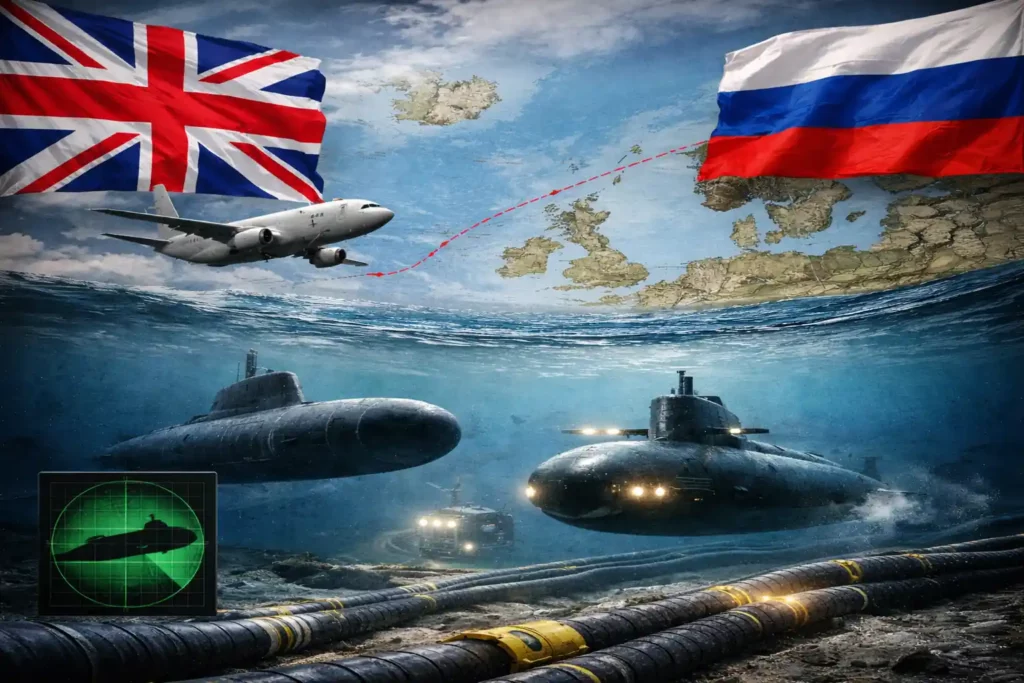
In early April 2026, the United Kingdom announced that it had tracked a group of Russian submarines operating in the North Atlantic over several weeks. Officials stated that the activity took place partly within the UK’s Exclusive Economic Zone and involved vessels associated with deep-sea operations. The disclosure drew attention not only because of the presence of military assets, but also because of the type of infrastructure believed to be involved.
According to statements from UK defense authorities, the submarines were operating in areas where undersea cables and energy pipelines are located. No damage or interference was reported. However, the nature of the activity raised concerns about the monitoring of critical infrastructure that supports global communications and energy systems.
The episode highlights a broader shift in how strategic competition is unfolding. Increasingly, attention is moving toward systems that are essential to economic and digital activity but remain largely out of public view. The seabed is one of those environments.
The Operation and Its Context
Available information suggests that several Russian submarines were tracked over a sustained period by British and allied forces. Surveillance reportedly involved maritime patrol aircraft, naval vessels, and underwater monitoring capabilities. The operation appears to have been managed through observation and tracking rather than direct engagement.
Reports indicate that the group included both a nuclear-powered attack submarine and specialized vessels designed for deep-sea operations. These specialized platforms are generally equipped to operate at significant depths and may be used for tasks such as inspection, maintenance, or research involving seabed infrastructure.
The presence of such vessels does not, in itself, establish intent. Submarine operations in international waters are not unusual, and naval powers routinely conduct patrols and technical missions. However, the proximity of these vessels to known infrastructure routes contributed to the concern expressed by UK officials.
By making the operation public, the UK signaled that it had maintained awareness of the activity and considered it noteworthy enough to disclose. This decision is part of a broader pattern in which governments are increasingly willing to publicize certain types of intelligence assessments.
The Role of Undersea Infrastructure
Undersea infrastructure forms a central component of modern global systems. Submarine cables carry the vast majority of international data traffic, including internet communications, financial transactions, and institutional data flows. These cables connect continents and enable real-time exchange of information across the global economy.
Energy infrastructure also extends across the seabed. Pipelines transport oil and natural gas between offshore production sites and onshore facilities. In addition, offshore energy generation is connected to land through subsea transmission systems.
These networks are characterized by high concentration and limited visibility. A relatively small number of routes carry large volumes of data and energy. While redundancy exists in some areas, it is not always sufficient to prevent disruption if key segments are affected.
Because of their location and structure, these systems can be difficult to monitor continuously. Maintenance and repair operations are complex and can require specialized equipment. As a result, any activity near such infrastructure tends to attract attention from states responsible for its protection.
Surveillance, Mapping, and Strategic Considerations
Monitoring infrastructure routes is not inherently unusual. Many aspects of submarine cable locations are publicly documented to support navigation and maintenance. However, more detailed technical mapping or close-range inspection may provide additional information about the physical characteristics and vulnerabilities of these systems.
From a strategic perspective, knowledge of infrastructure layout can have multiple uses. It can support maintenance planning, scientific research, or contingency preparation. It can also contribute to broader situational awareness in maritime environments.
Officials in the UK have indicated that the activity they observed was consistent with infrastructure monitoring. At the same time, no evidence has been presented publicly to suggest that any attempt was made to interfere with or damage these systems.
The distinction between observation and preparation is not always clear. Activities that appear similar at the technical level can have different strategic purposes depending on context. For this reason, states often respond to such operations with caution rather than immediate escalation.
Evolving Patterns of Competition
The incident fits into a wider pattern in which strategic competition extends beyond traditional military domains. Alongside land, air, and cyberspace, infrastructure systems are increasingly recognized as areas of potential vulnerability.
In recent years, there have been several cases of damage to undersea cables and pipelines in different regions. Some have been attributed to accidents, while others remain under investigation. These events have contributed to growing awareness of the importance of protecting infrastructure that supports both civilian and military functions.
At the same time, advances in technology have expanded the ability of states to operate at depth. Submersible systems, remote-operated vehicles, and improved navigation tools have made it easier to access and study the seabed environment.
This combination of reliance and accessibility has led to greater attention from policymakers and defense planners. The focus is not only on preventing disruption but also on understanding how such systems might be affected in different scenarios.
The Significance of Public Disclosure
The UK’s decision to disclose details of the submarine activity reflects a strategic choice. Governments do not always make such information public, particularly when it involves surveillance capabilities.
Public disclosure can serve several functions. It can demonstrate awareness and capability, signaling that certain types of activity are being monitored. It can also inform allies and partners, contributing to shared assessments of the situation. In addition, it can shape public understanding of emerging security concerns.
At the same time, disclosure requires careful framing. Statements must avoid speculation and remain grounded in verifiable observations. In this case, UK officials emphasized what had been observed without attributing specific intent beyond the monitoring of infrastructure.
This approach allows for transparency while limiting the risk of escalation. It also reflects the complexity of interpreting activities that occur in environments where direct evidence is difficult to obtain.
Legal and Governance Considerations
Undersea infrastructure operates within a complex legal framework. Different parts of the ocean are governed by different rules, depending on their distance from shore and their classification under international law.
Submarines are generally permitted to operate in international waters, including areas beyond territorial seas. Exclusive Economic Zones provide coastal states with certain rights related to resources, but they do not grant full control over navigation.
As a result, the presence of foreign vessels near infrastructure is not necessarily a violation of international law. This creates challenges for enforcement and response. Even when activity raises concerns, options for direct action may be limited.
Efforts to strengthen the protection of undersea infrastructure are ongoing, but they involve coordination among multiple states and stakeholders. The diversity of legal regimes and interests makes comprehensive solutions difficult to implement quickly.
Technology and Monitoring Capabilities
Monitoring activity on the seabed presents technical challenges. The ocean environment limits visibility and complicates communication. Detection systems rely on a combination of acoustic sensing, satellite tracking of surface vessels, and analysis of movement patterns.
Recent developments have improved these capabilities. Maritime patrol aircraft equipped with advanced sensors can cover large areas. Naval vessels can deploy sonar systems to detect underwater activity. Data analysis techniques can help identify unusual patterns that may warrant closer attention.
Despite these advances, coverage remains incomplete. The scale of the ocean and the depth of many infrastructure routes mean that continuous monitoring is not always feasible. This limitation contributes to the cautious interpretation of observed activity.
Managing Risk and Uncertainty
The situation described by the UK illustrates the role of uncertainty in contemporary security environments. Observed actions do not always translate directly into clear intent. As a result, responses tend to focus on managing risk rather than reacting to confirmed threats.
Tracking and observation allow states to maintain awareness without escalating the situation. Public disclosure adds a layer of signaling that can influence behavior without direct confrontation.
This approach reflects a broader trend in which states seek to balance vigilance with restraint. The goal is to reduce the likelihood of miscalculation while preserving the ability to respond if necessary.
Broader Implications
Although the incident took place in the North Atlantic, similar dynamics apply in other regions. Undersea infrastructure networks span multiple oceans and connect a wide range of countries. As reliance on these systems continues to grow, so does the importance of their security.
The issue extends beyond defense policy. It intersects with economic stability, technological development, and international cooperation. Ensuring the resilience of these systems requires input from governments, private operators, and international organizations.
In this context, individual incidents can serve as indicators of broader trends. They highlight areas where existing frameworks may need to be adapted and where new approaches may be required.
Conclusion: A Domain Coming Into Focus
The UK’s disclosure of submarine activity in the North Atlantic provides insight into an area of growing strategic importance. The seabed, once considered peripheral to security concerns, is now recognized as a space where critical systems are located and where state activity is increasing.
No damage was reported in this case, and no direct confrontation occurred. However, the attention given to the incident reflects a changing perspective on infrastructure and its role in global stability.
As technology continues to evolve and reliance on interconnected systems deepens, the importance of monitoring and protecting undersea infrastructure is likely to increase. The challenge for policymakers will be to address these issues in a way that maintains stability while adapting to new forms of activity.
The episode serves as a reminder that some of the most significant elements of the modern world operate out of sight, and that developments in these hidden domains can have wide-ranging implications.