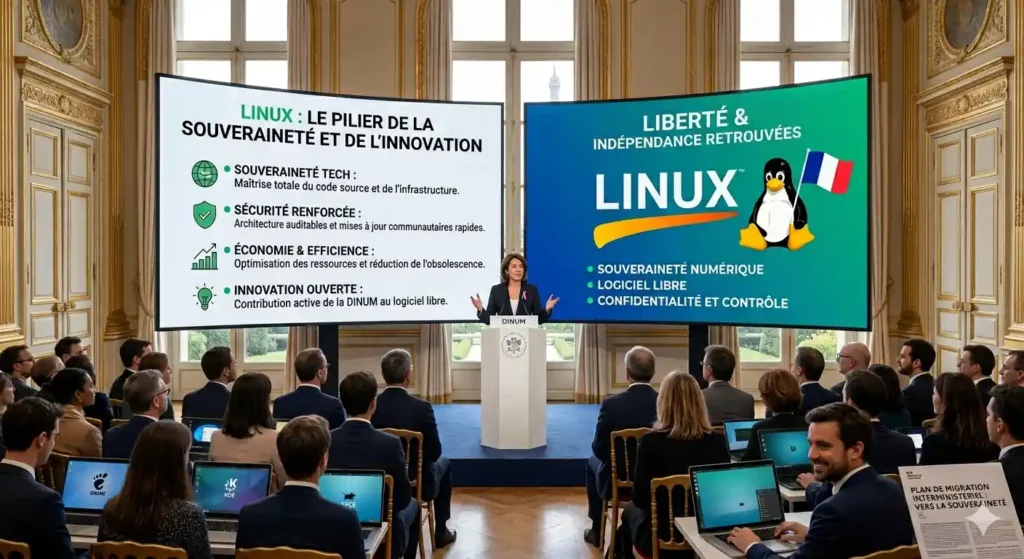
For years, “government switching to Linux” has been a familiar headline across Europe. Most of those efforts stalled, scaled back, or quietly disappeared. This time feels different, not because of the technology itself, but because of the intent behind it.
France is not simply experimenting with open-source alternatives. It is pursuing something far more structural: reclaiming control over its digital infrastructure in a world where software has become a strategic asset.
What was actually announced
The French state, through its central digital authority, has formalized a plan to reduce and eventually exit reliance on Microsoft Windows across government workstations. This is not framed as a routine IT upgrade. It is a coordinated state policy aligned with cybersecurity agencies, procurement bodies, and economic strategy units.
The key detail is often missed. There is no single deadline where everything flips to Linux. Instead, ministries are required to plan and execute gradual migrations, each adapting to its own constraints and systems.
Some administrations have already begun transitioning parts of their workforce. Others are still auditing dependencies and legacy systems. The result is uneven by design. This is a long-term directional shift, not a synchronized rollout.
The misleading simplicity of “switching to Linux”
At first glance, the story looks simple. Replace Windows with Linux and the job is done. In reality, the operating system is only the visible layer of a much deeper stack.
Government IT environments are built on decades of accumulated dependencies, including proprietary office formats, identity and authentication systems, internal applications tied to Windows environments, and cloud integrations that rely on specific vendor ecosystems.
Removing Windows means touching all of these layers.
France is therefore not replacing a single piece of software. It is attempting to unwind an entire dependency chain that connects daily workflows to foreign technology providers.
Linux plays a specific role here. It provides a base that can be modified, audited, and controlled internally. But it does not solve the broader challenge on its own.
Digital sovereignty as the real objective
The logic behind the move becomes clearer when viewed through the lens of digital sovereignty.
French policymakers are not primarily concerned with performance gains or licensing costs. Their concern is control. Software infrastructure determines how data is stored, who can access it, and under which legal frameworks it operates.
Much of the global software ecosystem is dominated by American companies. This creates a structural dependency that goes beyond technology. It introduces exposure to foreign legal systems, including laws that may allow access to data under certain conditions.
For a state, this raises strategic questions about who ultimately controls critical infrastructure and who defines the rules under which that infrastructure operates.
France’s answer is to reduce reliance on external actors wherever possible.
A full stack transition, not just an OS change
Focusing only on Linux obscures the scale of what is being attempted. The operating system is just one layer in a broader effort to rebuild a sovereign digital stack.
This includes replacing collaboration tools with state-controlled alternatives, developing or adopting European cloud infrastructure, rethinking data storage and transfer systems, and reducing reliance on non-European software vendors.
In practical terms, this means building parallel systems that can operate independently of dominant global platforms.
This is significantly more complex than an operating system migration. It is closer to reconstructing an entire digital ecosystem.
Why Linux is still central
Despite the broader scope, Linux remains a critical piece of the strategy.
Its value lies in its open nature, which allows full inspection and modification, its ability to avoid vendor lock-in, and its flexibility to adapt to specific security and administrative needs.
No proprietary system offers the same level of control. For a government pursuing autonomy, this makes Linux the most viable foundation.
At the same time, Linux introduces its own challenges, especially in environments heavily shaped by Windows-based workflows.
The difficult realities ahead
The ambition of the project should not obscure its difficulty. Large-scale migrations of this kind have historically faced significant obstacles.
Compatibility remains a major issue, as many internal tools are built specifically for Windows environments. Rewriting or adapting them requires time, resources, and coordination.
There is also the human factor. Millions of public sector employees are accustomed to existing tools, and even small changes in interface or workflow can slow adoption and reduce productivity in the short term.
Vendor ecosystems add another layer of complexity. File formats, enterprise integrations, and cloud services are often tightly coupled with existing platforms, making separation technically and organizationally demanding.
Finally, there is the question of continuity. This is a multi-year effort that depends on sustained political commitment, and changes in priorities or leadership could alter its trajectory.
Part of a broader European shift
France is not acting in isolation. Across Europe, there is growing interest in reducing dependence on foreign technology providers.
The language of strategic autonomy has become more prominent in policy discussions. Concerns about data control, cybersecurity, and economic resilience are pushing governments to reconsider long-standing dependencies.
What sets France apart is the scale and clarity of its approach. It is one of the few large countries attempting to translate these concerns into a concrete, system-wide strategy.
What this means beyond France
If the initiative succeeds, it could reshape how governments think about digital infrastructure. It may encourage other European states to accelerate similar transitions, potentially creating a larger ecosystem around open-source and sovereign technologies.
It could also challenge the dominance of major software vendors in the public sector, particularly in areas where governments have historically relied on external providers.
If it fails, the implications are just as significant. It would reinforce the difficulty of breaking away from deeply embedded technology ecosystems and highlight the practical limits of digital sovereignty.
The reality behind the headline
France has not fully switched to Linux. There is no sudden transformation taking place across the entire state apparatus.
What exists instead is a clear strategic commitment to move away from dependency on external software ecosystems, with Linux serving as a foundational element of that transition.
The real story is not about operating systems. It is about control, autonomy, and the recognition that in the modern world, software infrastructure is inseparable from national power.