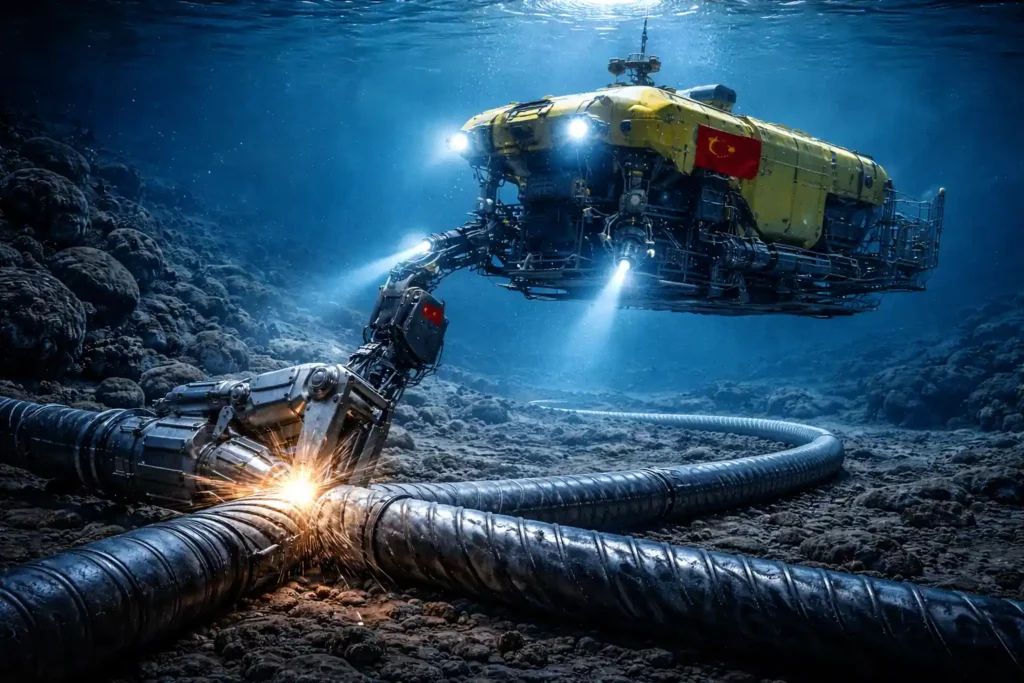
At depths where sunlight no longer reaches and where pressure exceeds what most machines can endure, a new class of engineering capability is quietly reshaping how nations think about underwater infrastructure. Recent reports describing China’s successful testing of a deep-sea device capable of cutting submarine cables at depths of up to 3,500 meters have sparked international attention not only for the technical achievement itself, but for what it suggests about the evolving strategic landscape beneath the oceans.
The system, described in Chinese technical reporting and linked to trials conducted aboard a research vessel operating in the South China Sea region, is based on an electro-hydrostatic actuator design. This mechanism integrates hydraulic force generation with electric motor control in a compact sealed unit, allowing mechanical operations to be performed under extreme pressure conditions found in the deep ocean. According to available descriptions, the device demonstrated precision cutting capability in a controlled underwater environment, marking a significant step forward in deep-sea robotics.
While the official framing of the technology emphasizes its potential use in subsea engineering, such as repairing damaged infrastructure, salvaging equipment, or maintaining underwater pipelines, its emergence has triggered wider discussion among analysts due to the critical importance of submarine communication cables in global systems.
The Invisible Backbone of the Internet
Submarine fiber optic cables are one of the least visible yet most essential components of the global digital economy. More than 95 percent of international data traffic, including financial transactions, government communications, cloud computing operations, and internet services, flows through a vast network of cables laid across the ocean floor. These cables span continents, linking data centers in North America, Europe, Asia, Africa, and beyond.
Despite their importance, these systems are physically fragile. Although armored and designed to withstand environmental stress, they remain vulnerable to natural hazards such as seismic activity, underwater landslides, and anchoring accidents. Repairs are typically carried out by specialized vessels that retrieve damaged sections and splice in replacements, a process that can take days or weeks depending on location and depth.
It is precisely this combination of importance and vulnerability that makes subsea cable systems a focal point in discussions about global infrastructure security. Any technology capable of interacting with or manipulating these systems at depth inevitably attracts scrutiny.
Deep-Sea Engineering as a Strategic Capability
The reported Chinese device operates at depths of up to 3,500 meters, which is significant because it places it within the operational range of many international submarine cable routes. Most deep-sea cables are laid at depths ranging from a few hundred meters on continental shelves to several thousand meters in abyssal plains, where human activity is minimal and monitoring is limited.
The engineering challenge at such depths is substantial. Pressure increases by roughly one atmosphere every 10 meters of depth, meaning that at 3,500 meters, the device must function under pressures approximately 350 times greater than at sea level. Materials, seals, electronics, and mechanical systems must all be designed to resist deformation, corrosion, and failure under these conditions.
Electro-hydrostatic actuators are particularly relevant in this context because they eliminate the need for long hydraulic lines and external pumps, instead embedding power generation and actuation within a single compact system. This improves reliability and reduces the risk of leakage or pressure imbalance, both of which are critical concerns in deep-sea environments.
From an engineering perspective, the successful demonstration of such a system represents progress in a field that also supports scientific exploration, offshore energy development, and underwater robotics.
Dual-Use Technology and Interpretation Challenges
A central issue raised by the development is the concept of dual-use technology. In modern engineering and defense analysis, many systems can serve both civilian and strategic purposes depending on how they are deployed. Deep-sea robotics, advanced sensors, autonomous underwater vehicles, and subsea manipulation tools all fall into this category.
The device described in recent reports is no exception. In civilian terms, it could be used for repairing undersea pipelines, conducting salvage operations on wrecks, or supporting marine scientific research. In more sensitive contexts, any technology capable of interacting with critical subsea infrastructure naturally raises questions about potential non-civilian applications.
However, it is important to distinguish between technological capability and intent. The existence of a tool does not itself determine how it will be used. Many of the same technologies used in offshore energy extraction are also applicable to naval research or infrastructure inspection.
This ambiguity is a defining feature of modern technological development, particularly in domains such as the deep ocean, where visibility is low and operational activities are difficult to monitor.
The Expanding Competition Below the Surface
Over the past decade, there has been a noticeable increase in global attention to seabed infrastructure. Governments and private operators have become more aware of the strategic importance of submarine cables, pipelines, and undersea data routes. This has led to increased investment in monitoring systems, redundancy planning, and repair capabilities.
At the same time, several countries have expanded their deep-sea research programs and underwater robotics capabilities. These efforts are often framed as scientific or industrial initiatives, but they also contribute to broader national capacity in maritime environments.
The ocean floor is increasingly viewed as a domain of strategic infrastructure, similar in importance to airspace or orbital systems. Unlike satellites, however, undersea systems are physically accessible and often difficult to continuously monitor, creating a unique set of security challenges.
Infrastructure Vulnerability and Global Dependence
One of the underlying reasons submarine cables attract attention is the concentration of global dependency on a relatively small number of physical systems. While redundancy exists, disruptions to key cable routes can still have significant regional impacts on internet connectivity, financial transactions, and communications.
Historical incidents have demonstrated that cable disruptions can occur due to fishing activity, earthquakes, or accidental anchoring. Repairs, while routine, require specialized vessels and can be logistically complex depending on location.
This physical vulnerability contrasts with the perception of the internet as a decentralized and abstract system. In reality, the global digital network is grounded in tangible infrastructure that can be mapped, accessed, and potentially disrupted.
Scientific Advancement and Geopolitical Interpretation
From a purely scientific standpoint, the development of deep-sea manipulation tools reflects progress in robotics, materials science, and underwater engineering. Operating at extreme depths requires solving complex problems related to pressure resistance, energy efficiency, and remote control precision.
However, technological advancements rarely exist in isolation from geopolitical interpretation. In an environment where major powers are increasingly attentive to infrastructure resilience, even civilian engineering projects can be viewed through a strategic lens.
This does not necessarily imply hostile intent, but rather reflects the broader reality that infrastructure technologies often sit at the intersection of science, industry, and security policy.
The Role of Transparency and Information Gaps
One of the challenges in assessing developments in deep-sea technology is the limited availability of independently verifiable data. Much of the available information comes from institutional reports, state-linked media, or secondary analysis. The deep ocean is inherently difficult to observe directly, which creates natural information asymmetries.
As a result, interpretations of such technologies often vary significantly depending on the source, context, and analytical framework applied. Engineering communities may focus on technical feasibility and design innovation, while policy analysts may emphasize strategic implications.
Both perspectives are valid, but they address different aspects of the same development.
Conclusion: A New Layer of Infrastructure Awareness
The reported testing of a deep-sea cable cutting device at extreme depths highlights a broader trend in global infrastructure awareness. As human systems extend further into the ocean floor, the technologies required to build, maintain, and interact with them are becoming more advanced and more widely distributed.
Whether viewed as a scientific milestone in underwater robotics or as part of a broader pattern of dual-use technological development, the significance of such systems lies in their connection to the hidden infrastructure that underpins global communication.
The deep ocean, once considered remote and largely inaccessible, is increasingly becoming an active domain of engineering capability and strategic interest. As this transformation continues, the line between civilian infrastructure maintenance and strategic capability will likely remain a subject of ongoing global discussion.