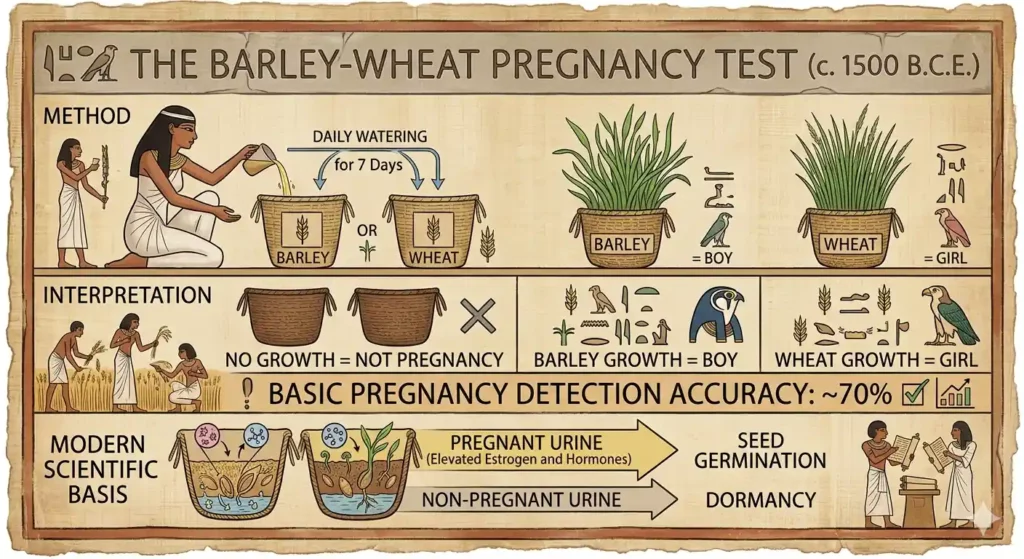
Long before the rise of laboratory diagnostics, ancient Egyptian physicians developed one of the earliest recorded biological tests for pregnancy. Found in medical texts such as the Ebers Papyrus (circa 1550 B.C.E.), the method appears deceptively simple. A woman suspected of being pregnant would urinate on bags of barley and emmer wheat over a period of days. If the grains germinated, pregnancy was considered likely. If they did not, the result was interpreted as negative.
Some later interpretations added symbolic meaning, suggesting that barley growth indicated a male child and wheat indicated a female. However, this distinction is not supported by strong historical evidence and is generally considered a later folkloric addition rather than part of the original diagnostic method.
Despite its ancient origins, the method continues to attract scientific curiosity because it appears to reflect a repeatable biological effect rather than pure superstition.
A Test That Modern Science Revisited
In the mid-20th century, researchers revisited this ancient procedure to evaluate whether it had any physiological basis. A frequently cited study from the 1960s reported that urine from pregnant women appeared to promote seed germination more often than urine from non-pregnant women or men.
However, modern interpretation of these findings is more cautious. While some differences in germination were observed under certain conditions, the results were not consistent enough to qualify as a reliable diagnostic method by modern medical standards. Factors such as soil quality, seed viability, temperature, and urine concentration can all significantly influence outcomes.
Even so, the observation remains intriguing. It suggests that ancient practitioners may have been noticing a real but inconsistent biological interaction between human urine and plant growth.
Possible Biological Explanations
The exact reason behind the reported germination effect is still not fully understood, and no single mechanism has been definitively proven. Several hypotheses have been proposed.
One possibility is that hormonal changes during pregnancy alter the composition of urine in ways that could influence seed germination. Pregnancy involves elevated levels of hormones such as estrogens and human chorionic gonadotropin, which significantly change metabolic processes in the body.
Another factor may involve nitrogen compounds in urine. In non-pregnant individuals, higher concentrations of urea can inhibit or damage seeds. Changes in concentration or composition during pregnancy could potentially reduce this inhibitory effect under certain conditions.
Comparisons are sometimes made between human hormones and plant growth regulators such as gibberellins. However, this remains a conceptual analogy rather than a confirmed biochemical equivalence.
Overall, the most likely explanation is that the test produced inconsistent but occasionally observable effects that were interpreted through an empirical, experience-based medical system.
Ancient Medicine as Experimental Observation
Rather than being purely symbolic, Egyptian medicine often combined ritual context with systematic observation. The grain-based pregnancy test reflects a broader principle in ancient medical practice in which the body was understood in relation to environmental and agricultural cycles.
Barley and emmer wheat were not only staple crops but also symbols of fertility and renewal. Their use in diagnostic testing reflects a worldview in which human reproduction and agricultural growth were seen as interconnected natural processes.
This suggests that ancient Egyptian physicians were engaging in early forms of empirical experimentation, even if they lacked modern controls, statistical methods, or biochemical theory.
Transmission Through History
The idea of using biological substances to infer pregnancy did not disappear with the decline of ancient Egypt. Variations of similar urine-based tests appear in medieval European and early modern medical traditions, often stripped of their original cultural and observational context.
Over time, these practices became increasingly symbolic or speculative, particularly as humoral theory dominated European medicine. It was not until the development of modern endocrinology in the 20th century that pregnancy could be reliably detected through specific hormones such as hCG, leading to the creation of modern pregnancy tests.
From Grain to Hormones: A Continuity of Inquiry
Although modern pregnancy tests rely on immunological and molecular detection, the underlying goal remains the same: identifying subtle biological signals that indicate early pregnancy.
The ancient Egyptian grain test represents one of the earliest documented attempts to detect an internal physiological state using an external biological system. Even if imperfect, it demonstrates a long-standing human effort to translate invisible biological processes into observable outcomes.
From seeds in Nile soil to antibody-based diagnostic strips, the history of pregnancy testing reflects a continuous refinement of the same fundamental question: how can early life inside the body be detected from the outside world?
References
Ebers Papyrus (circa 1550 B.C.E.), ancient Egyptian medical text.
Berlin Medical Papyrus (Papyrus Berlin 3038), Egyptian Museum, Berlin.
Nunn, J. F. (1996). Ancient Egyptian Medicine. University of Oklahoma Press.
Historical analyses of urine-based pregnancy testing in early medical literature.