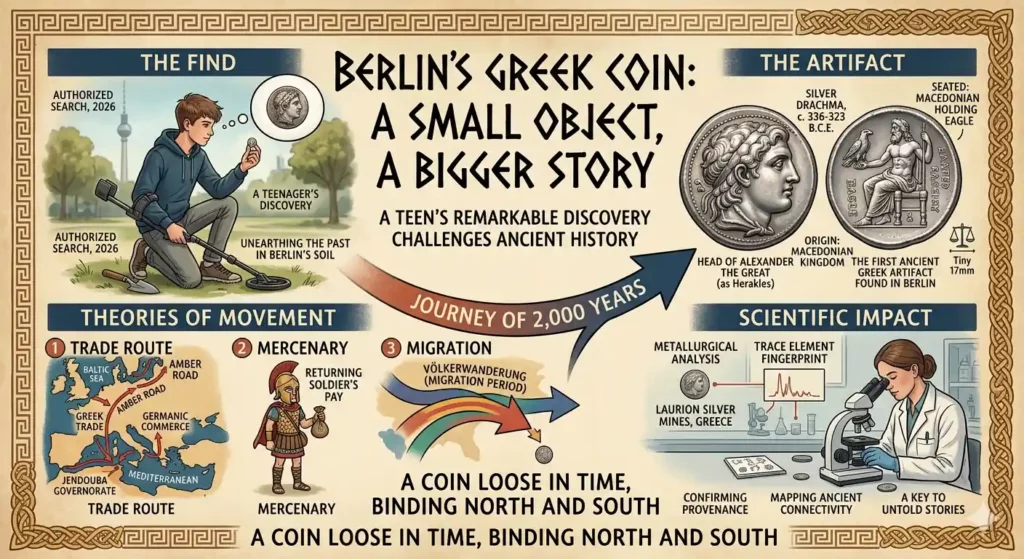
A routine walk through Berlin turned into an unexpected archaeological story when a 13-year-old discovered a small ancient coin later identified as originating from the Hellenistic world. The find has since been confirmed by specialists and described as one of the rarest ancient objects ever recorded in the city under such circumstances.
While headlines often simplify it as a “Greek artifact found in Berlin,” the reality is more precise and more interesting in context.
What was actually found
The object is a small bronze coin dated to the Hellenistic period, likely around the 3rd century BCE. It is associated with the ancient city of Troy (Ilion), which at the time was part of the broader Greek cultural and economic sphere following the conquests of Alexander the Great.
Coins from this period were widely circulated across the eastern Mediterranean. They often featured symbolic imagery linked to city identity and mythology, and were used as everyday currency in trade networks that extended far beyond their place of minting.
This particular coin is believed to depict Athena on one side, a common motif in Greek coinage, reflecting the city’s cultural alignment with Greek religious and political imagery.
Why it matters in Berlin
What makes the discovery notable is not the coin itself, but its location and context.
Ancient coins are occasionally found in European cities, but finds that can be confidently linked to undisturbed archaeological layers are rare in a modern urban environment like Berlin. The city has undergone extensive construction, redevelopment, and soil disturbance over centuries, which makes intact ancient contexts difficult to preserve.
Archaeologists examining the coin concluded it was authentic and ancient, but they remain cautious about how it arrived at the site. At this stage, there is no evidence that it indicates a direct ancient settlement or sustained Greek presence in the area.
Instead, the more likely explanations include later soil movement, historical collection loss, or redistribution through human activity over time.
How a child made the discovery
According to the report, the coin was found by a teenager during a casual walk. It was later submitted for expert evaluation, where archaeologists confirmed its age and origin.
Such finds are not unheard of in Europe, where modern urban environments often overlap with deeply layered historical ground. However, discoveries made outside formal excavation contexts still require careful verification before being integrated into archaeological records.
Why archaeologists are cautious
Despite the excitement around the discovery, specialists are careful not to overinterpret it.
A single coin, even when authenticated, does not automatically indicate direct trade routes or historical settlement patterns. Ancient coins were widely circulated, reused, and transported long after their original minting period. They can also enter archaeological layers through later disturbances.
For that reason, researchers treat the Berlin find as an isolated but interesting artifact rather than evidence of a broader historical connection between ancient Greece and the region.
The wider historical backdrop
During the Hellenistic period, following the campaigns of Alexander the Great, Greek influence spread across a vast territory stretching from the Mediterranean to parts of Central Asia. Coinage from Greek cities and successor kingdoms circulated widely within these interconnected economies.
Troy itself held symbolic importance in the Greek world, especially due to its mythological role in Homeric tradition. Coins issued in the region often carried cultural references that reinforced that identity.
This broad circulation makes it entirely plausible for such objects to appear far from their origin, even if the path they took is no longer traceable.
Why the story gained attention
Part of the public interest comes from the contrast between the setting and the object. A small ancient coin discovered in a modern European capital creates an immediate sense of historical depth beneath everyday life.
It also fits a familiar pattern in archaeology reporting: unexpected finds in urban environments that hint at layered histories beneath contemporary cities.
However, archaeologists emphasize that such discoveries are best understood as individual data points rather than dramatic historical revelations.
Conclusion
The Berlin coin discovery is a verified and interesting archaeological find, but its significance lies in its rarity and preservation context rather than in rewriting historical narratives.
It is a reminder that ancient objects still surface in modern cities, not as evidence of hidden civilizations beneath them, but as fragments of long and complex patterns of movement, trade, and loss across centuries.