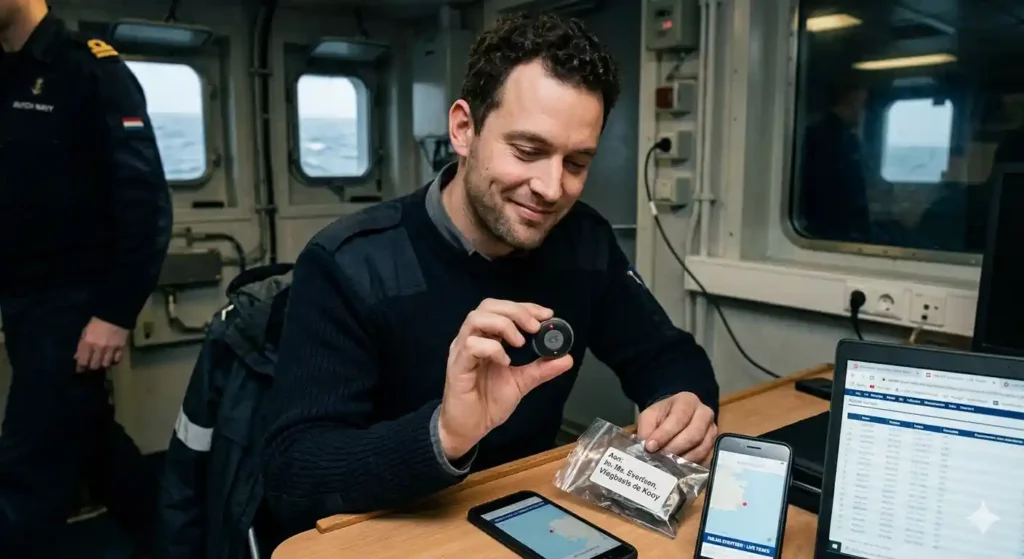
A Dutch broadcaster has demonstrated how a modern warship can be tracked for a short period using nothing more than a low-cost Bluetooth tracker hidden in mail sent through official military channels. The case involved the Royal Netherlands Navy frigate HNLMS Evertsen, deployed as part of a NATO carrier strike group in the Mediterranean.
While the headline suggests a dramatic breach, the reality is more nuanced. The incident highlights less a “hack” and more a combination of predictable logistics, consumer tracking infrastructure, and already partially visible naval movements.
What actually happened
According to reporting from Dutch media, journalists placed a small Bluetooth tracking device inside postal mail and sent it through the military mail system to the ship.
The device was not detected during handling and eventually reached the frigate while it was operating at sea. Once onboard, it began transmitting location data through nearby consumer devices capable of relaying Bluetooth signals to the internet.
The tracker remained active for roughly 24 hours before it was discovered during internal mail processing and disabled by crew members.
Why the ship was not completely invisible
An important detail often missing from simplified coverage is that the frigate was not operating in complete stealth.
At the time, HNLMS Evertsen was part of a NATO carrier strike group supporting the French aircraft carrier Charles de Gaulle in the Mediterranean. Like most naval vessels in international waters, it was operating in an environment where partial tracking through systems such as AIS and routine naval coordination already exists to some degree.
This means the Bluetooth tracker did not reveal a hidden ship. Instead, it provided more continuous and precise location updates on a vessel whose general movements were already partially inferable through other means.
How Bluetooth tracking actually works in this context
The device used is similar to consumer tracking tags designed for everyday items like keys or luggage. These devices do not have satellite capability and do not independently transmit long-range GPS data.
Instead, they rely on a network effect. The tracker emits a short-range Bluetooth signal that is detected by nearby smartphones or connected devices. Those devices then upload location information to a cloud system, which allows the owner to see the tracker’s position.
In maritime environments, this only works when compatible devices are nearby, which can include crew smartphones, onboard systems with connectivity, or devices encountered when the ship is in port or near populated areas.
The result is not direct tracking of the ship itself, but indirect tracking through the presence of civilian electronics in the environment.
The real security gap: physical delivery, not hacking
The most significant issue revealed by the incident was not electronic interception, but physical access.
The broadcaster exploited standard military mail procedures, which allow personal mail to be delivered to deployed personnel. Such mail is typically screened but not always opened or fully scanned, depending on format and risk assessment protocols.
In this case, the device was small enough to pass inspection and enter the ship undetected.
This makes the incident less about cybersecurity and more about operational security in logistics chains.
Why this matters to militaries
Defense analysts have emphasized that the concern is not the sophistication of the method, but its simplicity and scalability.
No hacking was involved. No network intrusion occurred. No advanced intelligence capability was required. A consumer device and access to a trusted delivery channel were enough to generate usable tracking data.
This raises broader concerns because similar methods could theoretically be repeated across different platforms, especially where physical access and civilian tracking ecosystems overlap.
Why the reaction is still serious
Even though the tracking window was short and the data overlap with existing visibility systems was limited, militaries take these incidents seriously for structural reasons.
Modern naval operations depend on layered security. Even partial exposure of movement patterns can be sensitive in coordinated deployments like carrier strike groups, where the position of one vessel can reveal broader formation behavior.
The concern is not what was revealed in this case, but how easily a similar approach could be repeated in different contexts.
The broader pattern behind the story
This incident fits into a wider trend where civilian technology ecosystems increasingly intersect with military environments.
Consumer tracking devices, fitness apps, connected smartphones, and logistics systems have all been shown to unintentionally expose movement patterns in different contexts. The Dutch case is notable because it combines physical access, consumer hardware, and maritime operations in a single example.
It reflects a shift in operational security challenges. The risk is no longer limited to digital intrusion or signal interception, but also includes everyday systems designed for convenience rather than security.
Conclusion
The tracking of HNLMS Evertsen using a €5 Bluetooth device was not a sophisticated cyberattack, nor did it reveal a hidden fleet. Instead, it exposed how easily consumer tracking systems can intersect with military logistics when physical access is possible.
The key takeaway is not that warships can be “hacked by Bluetooth,” but that modern operational security increasingly depends on controlling small, ordinary vectors that were never designed with military environments in mind.