Imagine reading a simple sentence you have spoken hundreds of times. You know every word, understand the meaning, and feel completely at ease. Then someone switches on a small acoustic device.
Almost immediately, your speech begins to unravel. Words come out in slow motion. Syllables collide, sounds loop involuntarily, and your voice stumbles into a hesitant rhythm. The harder you try to correct yourself, the worse the distortion becomes. Yet, the machine does not knock you unconscious, block your hearing, or alter your understanding of language. It does not hack your thoughts or apply physical pressure. It does something far simpler by playing your own voice back to you, delayed by a fraction of a second. That tiny delay is enough to hijack one of the most delicate real-time feedback loops in the human brain.
What Is a Speech Jammer?
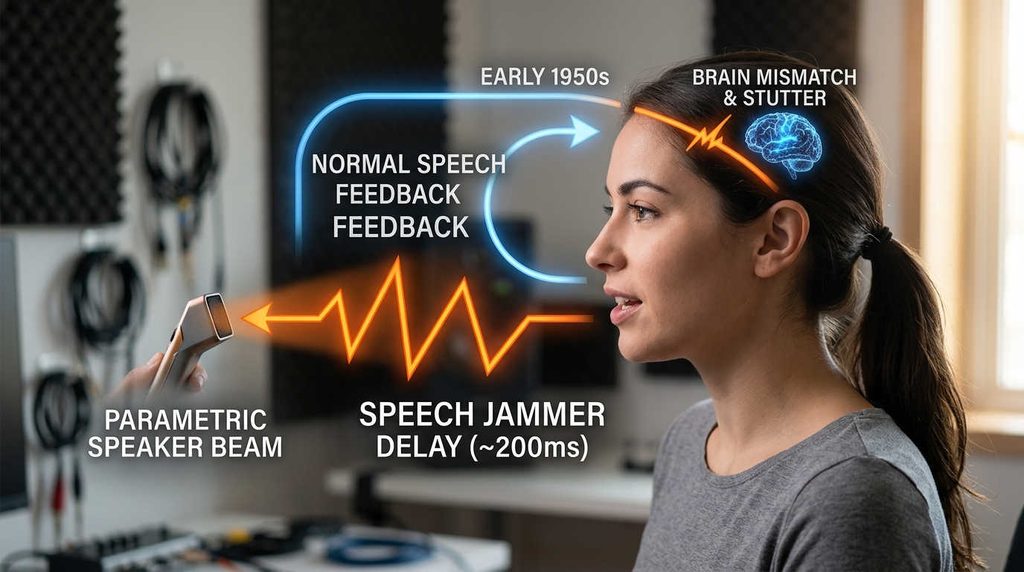
A speech jammer is a directional acoustic device that disrupts human speech using a phenomenon known as Delayed Auditory Feedback, or DAF. The concept relies on a straight signal path where a directional microphone captures a speaker’s voice from a distance, an electronic circuit introduces a precise time delay around one to two hundred milliseconds, and a parametric speaker beam redirects that delayed audio directly back at the speaker’s ears. When configured correctly, the returned signal causes the speaker to stutter, slow down, repeat syllables, or stop talking entirely.
While creator demonstrations on video platforms, such as musician Benn Jordan testing homemade rigs on pedestrians for cash prizes, frequently go viral, the core technology is not a modern breakthrough. The speech jammer takes an established laboratory phenomenon studied since the middle of the twentieth century and attaches targeted acoustic engineering to it.
The Neuroscience of Real-Time Feedback
We tend to think of speech as a linear, one-way command where the mind formulates an idea, sends signals to the vocal cords, and outputs sound. In reality, human speech operates as a continuous, closed-loop control system. To produce fluent speech, your brain must coordinate dozens of muscles controlling respiration, vocal fold tension, tongue posture, jaw movement, and lip alignment. To maintain control over this complex system, the brain relies on instant sensory updates, and your own voice is the primary source of that update loop.
When you speak, sound travels through air and bone conduction to your inner ear, your auditory cortex processes the incoming sound in milliseconds, and your brain compares what it expects to hear against what it actually hears to adjust timing and articulation automatically. A speech jammer breaks this loop. By throwing acoustic data back at you a fraction of a second late, the device creates a severe sensory mismatch. Your auditory system reports on words you finished saying a split second ago, while your motor cortex is already attempting to execute the next sequence of sounds. The result resembles attempting to steer a vehicle when the display lags behind real-time motion, meaning every correction you make is based on outdated data, driving the system further into instability.
From Cold War Labs to the Ig Nobel Prize
The history of delayed feedback research spans over seven decades. In 1950, American researcher Bernard S. Lee published a seminal paper in the Journal of the Acoustical Society of America while working at the Signal Corps Engineering Laboratories in New Jersey. Lee demonstrated that feeding a speaker’s voice back through delayed tape loops produced severe fluency disruptions.
Decades later in 2012, Japanese researchers Kazutaka Kurihara and Koji Tsukada modernized the concept by developing a standalone device dubbed the SpeechJammer. Their innovation was eliminating the need for headphones by pairing directional microphones with narrow-beam ultrasonic speakers, earning them the 2012 Ig Nobel Prize in Acoustics for disrupting speech non-invasively without causing physical pain. Today, portable, open-source variations built with off-the-shelf digital signal processors regularly circulate across social media and tech communities.
Why Some People Resist the Jamming Effect
Despite dramatic public demonstrations, delayed auditory feedback does not affect every individual uniformly. Resistance varies due to several biological and environmental factors. Individuals rely on auditory feedback to varying degrees, as some speakers depend more heavily on tactile and proprioceptive feedback from their tongue, lips, and palate rather than acoustic feedback.
Speaking rate also plays a role, with fast, highly rhythmic speakers often experiencing greater disruption than slow, deliberate speakers. Furthermore, the brain possesses significant neuroplasticity, meaning that with repeated exposure or conscious focus, individuals can train themselves to ignore incoming audio cues and rely strictly on motor memory. If the delayed playback lacks sufficient volume, directional focus, or precise timing adjustment, the disruptive effect weakens significantly.
Acoustic Realities Versus Popular Myths
Because speech jammers appear to strike speakers mute at a distance, online commentary occasionally speculates about covert military use or psychological warfare. Evaluating the technology requires separating acoustic realities from popular myths. In terms of cognitive effect, the device merely disrupts real-time motor coordination rather than wiping memory or controlling thought processes.
The operational mechanism delivers targeted audio feedback at a delayed interval rather than using sub-audible waves or radiation to alter brain chemistry. Unlike the idea of a completely silent beam, both the target and nearby observers can hear the delayed playback sound. The system also suffers from clear operational limitations, becoming completely ineffective if the subject wears earplugs, noise-canceling gear, or simply learns to ignore the audio.
What Speech Jammers Reveal About Mind Control
The true significance of the speech jammer lies outside tactical applications or internet pranks. It offers a clear, non-invasive window into cognitive neuroscience. Fluent speech feels effortless because our nervous system conceals the immense computational work running in the background. Every syllable requires continuous prediction, real-time error detection, and rapid muscular adjustments.
By introducing a tiny delay into that internal conversation, the speech jammer brings hidden neurological machinery into plain sight, proving that even as you speak, your brain is listening to every word.