History is rarely written by the victors alone; it is carved into stone, woven into language, and buried beneath the official chronicles of statecraft. For centuries, the narrative surrounding the fall of Al-Andalus has been framed through the lens of inevitable conquest, a definitive rupture that purportedly wiped away an entire civilization in 1492. Yet, in the rugged mountain villages of the Alpujarra and within the intricate stucco work of the Alhambra, a different reality persists. Spanish historian, art historian, and Arabist José Miguel Puerta has dedicated his life to uncovering that reality, peeling back the layers of institutional amnesia to reveal an Al-Andalus that was never truly extinguished.
In a wide-ranging conversation for the Diwan Al-Andalus podcast, Puerta offers a profound reassessment of Andalusian history. Drawing on decades of archival research, philological study, and a deeply personal connection to the landscapes of southern Spain, he challenges conventional historical myths. He explores the fierce resistance of the Moriscos, the poetic geometry of the Alhambra, the forgotten legacy of the Madrasah Yusufiyya, and the quiet, organic survival of an Islamic heritage in the heart of modern Europe.
The Soil of Resistance: Growing Up Morisco in the Alpujarra
To understand Puerta’s perspective on Al-Andalus, one must look to the geography of his upbringing. Born and raised in southern Granada, in a region historically referred to by Ibn al-Khatib as Wadi Ash and closely linked to the Alpujarra, Puerta grew up immersed in a landscape marked by the echoes of the Morisco resistance. This was the terrain where the remnants of the Muslim population, legally forced to convert to Christianity, secretly and openly fought to preserve their identity, their language, and their ancestral ties to the soil.
Puerta recalls how, during his youth in the late 1970s and 1980s, local communities maintained unwritten connections to their past. Long before he formally studied Arabic or trained as an art historian, the signs were present in everyday life: in the agricultural vocabulary, the irrigation channels known as acequias, the culinary traditions, and the oral histories passed down through families. This was not a sanitized, museum-ified history, but a living culture embedded in the rural architecture and the collective memory of the region’s inhabitants.
The history of the Morisco uprisings, particularly the rebellion led by Fernando de Valor—who adopted the dynastic name Ibn Umayya to symbolize his connection to the Andalusian past—reveals a chapter of Spanish history often glossed over in standard curricula. The Castilian crown did not merely sweep through Granada unopposed; it faced fierce, organized resistance in the rugged valleys of the Alpujarra. The Crown was forced to deploy its most formidable military assets, drawing seasoned troops from Italy and securing direct financial and political backing from the Vatican.
Puerta notes that historical records detailing this conflict—such as the meticulous chronicles written by royal scribes—offer a paradox. While intended to document the subjugation and redistribution of Moorish properties down to the last olive tree and lemon grove, these property distribution books inadvertently serve as exhaustive archives for modern historians. They record the names, homes, and belongings of families whose lives were systematically uprooted, providing granular evidence of an entire civilization being forcibly dismantled and replaced.
The Myth of the Bloodless Fall and the Birth of Imperial Spain
The year 1492 is traditionally taught as a monolithic turning point: the capitulation of Granada, the unification of the Catholic Monarchs, and Christopher Columbus setting sail for the Americas. Puerta contextualizes this momentous year as the birth pangs of Spanish imperialism, a dual movement that simultaneously crushed internal diversity while projecting power outward across the globe.
The surrender of Boabdil, the last Nasrid king of Granada, is frequently misinterpreted as an act of cowardice or effortless submission. Puerta reframes this event through the realities of geopolitical pressure. Surrounded, outmatched by a militarized Castilian state transitioning into an imperial power, and facing internal factionalism, Boabdil negotiated a capitulation agreement designed to safeguard the lives, properties, and religious freedoms of his people. Yet, these guarantees were short-lived. The subsequent decades saw a systematic campaign of forced assimilation, the purging of Arabic, the burning of countless manuscripts, and the eventual expulsion of the Moriscos throughout the sixteenth and early seventeenth centuries.
Crucially, 1492 also marked the publication of Antonio de Nebrija’s Gramática de la Lengua Castellana, the first formal grammar of the Spanish language. Puerta points out the profound structural symmetry of this development: as Latin receded as the exclusive language of administration and culture, Spanish was codified to serve as an administrative and ideological instrument for a newly emergent global empire. The subjugation of Granada and the linguistic unification of the Iberian Peninsula were two sides of the same coin, laying the groundwork for a centralized state that sought to eliminate cultural pluralism in favor of religious and linguistic homogeneity.
The Alhambra: An Architectural Diwan of Poetry and Cosmos
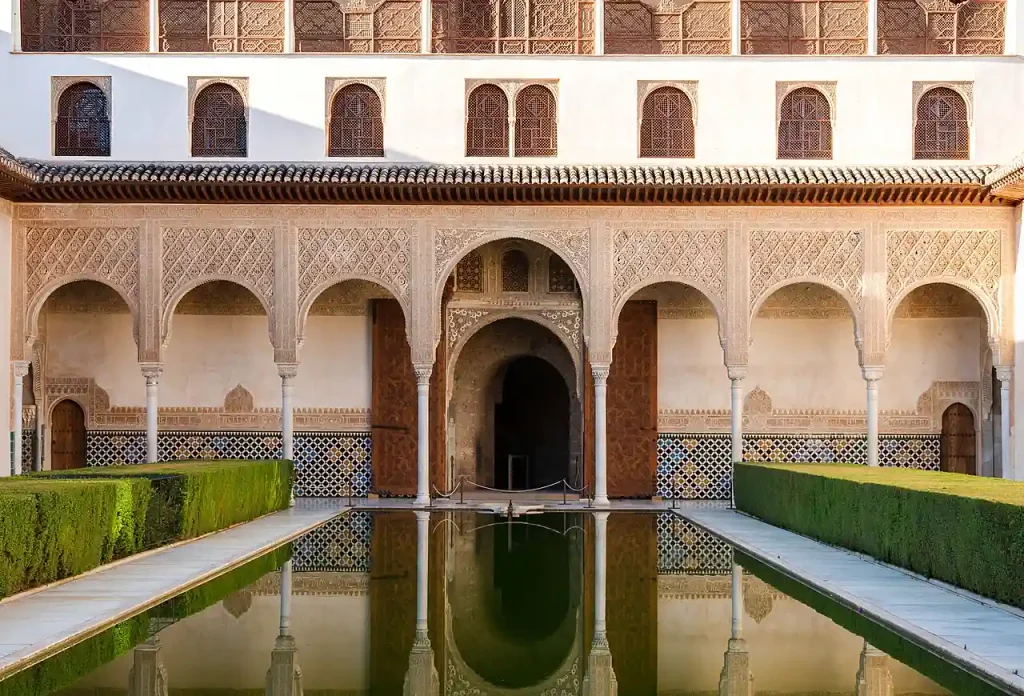
If the political history of post-conquest Granada was one of erasure, the physical survival of the Alhambra stands as an extraordinary counter-narrative. For Puerta, the Alhambra is neither a static monument nor a mere display of royal opulence; it is a complex cosmological text, a “poetic palace” whose walls speak in the voice of a bride adorned for her wedding.
During his university studies in Granada during the late 1970s and early 1980s, Puerta experienced a transformative intellectual awakening when he first began to decipher the Arabic inscriptions covering the Alhambra’s walls. At the time, standard academic training in art history largely overlooked the Andalusian corpus, focusing instead on European medieval and Renaissance styles. Driven by personal curiosity, Puerta taught himself Arabic, using dictionaries and epigraphic remains as his primary texts, eventually becoming one of Spain’s leading scholars on Arabic calligraphy and Andalusian aesthetics.
Through Puerta’s analysis, the Alhambra reveals itself as a synthesis of engineering, philosophy, and literature. Water is not merely a decorative element, but an architectural substance that provides cooling, spiritual contemplation, and acoustic resonance, serving as a dynamic mirror that reflects the palace back onto itself. The gardens and courtyards embody an advanced ecological philosophy that harmonized human habitation with the natural world long before modern ecological movements emerged.
Furthermore, the epigraphy of the Alhambra transforms architecture into literature. The Nasrid rulers commissioned court poets and viziers, such as Ibn al-Khatib, to compose verse specifically tailored to individual rooms and courtyards. These poems were then rendered in sophisticated architectural scripts—including developments of the classical Kufic script into floral and structural forms—that wrap around arches, capitals, and walls. The building itself addresses the visitor in the feminine voice of a bride, declaring its own beauty, perfection, and majesty.
In the Hall of the Ambassadors, beneath a magnificent wooden ceiling comprising over 8,000 individual geometric pieces representing the seven celestial spheres described in the Quran, the architectural program reaches its cosmological zenith. Here, power is legitimized not merely through military might, but through alignment with divine order. The omnipresent epigraphic motto of the Nasrid dynasty—La ghalib illa Allah (“There is no victor but God”)—anchors this philosophy. While scholars note historical precedents for the phrase in earlier Almohad contexts, its definitive architectural canonization in the Alhambra serves as a constant reminder of human finitude in the face of the divine.
The Madrasah Yusufiyya: Recovering a Lost Intellectual Beacon
Beyond the royal confines of the Alhambra, Granada held another crucial intellectual institution: the Madrasah Yusufiyya. Founded by Sultan Yusuf I in 1349, it was the first and only official institution of higher learning established in Nasrid Granada. Here, scholars, jurists, mathematicians, and astronomers gathered to study everything from Quranic interpretation and jurisprudence to arithmetic, medicine, and prosody.
Following the conquest, the physical building of the Madrasah suffered a fate typical of many Islamic institutions in post-1492 Granada: it was converted into the municipal headquarters of the city council (Casas Consistoriales) in 1505, altering its function while preserving fragments of its architectural core, including its prayer hall and exquisite mihrab. For centuries, its true identity as an intellectual powerhouse was largely obscured, reduced in local consciousness to an old municipal building.
Puerta discusses his recent collaborative efforts with academic colleagues in Granada to restore the memory of the Madrasah Yusufiyya. By cataloging surviving manuscripts, reconstructing the biographies of the scholars who taught there—such as the jurist and polymath Ibn Sammak al-Makri and various prominent mathematicians and astronomers—and preparing new scholarly publications, Puerta and his peers are working to bring this forgotten institution back into the public light. Plans to establish a dedicated interpretive space within the historic building aim to educate visitors about the rigorous scientific and literary traditions that flourished in Nasrid Granada, ensuring that the Madrasah is remembered not as a footnote, but as a vibrant center of medieval enlightenment.
The Duality of Modern Spain: Amnesia and Organic Revival
One of the most compelling themes in Puerta’s analysis is the psychological and cultural duality that characterizes modern Granada and southern Spain at large. On one hand, society often exhibits what Puerta terms a form of “psychological dissociation”—celebrating the Alhambra as an exotic tourist attraction and a universal symbol of civic pride while remaining largely disconnected from the linguistic, cultural, and historical realities of the civilization that created it. Public festivals and municipal pageantry sometimes invoke historical tropes without a deep engagement with the actual heritage, creating a tension between commercialized tourism and historical authenticity.
On the other hand, Puerta observes a spontaneous, organic reconnection with Andalusian heritage among younger generations, artists, and intellectuals. Without formal institutional prompting, students at fine arts academies, musicians, and writers find themselves instinctively drawn to the visual geometry, poetic rhythms, and architectural language of Al-Andalus. Figures like the legendary poet Federico García Lorca—whose deep engagement with Arabic-Andalusian verse, Oriental aesthetics, and figures like Omar Khayyam has long been under-appreciated by mainstream literary criticism—demonstrate that Spain’s cultural DNA cannot be artificially severed.
This organic revival is further supported by institutional bridges, such as the European-Arabic Foundation (Fundación Euroárabe) in Granada, which has expanded its cultural programming to embrace not only Arabic studies but also Amazigh culture, reflecting the rich, multi-ethnic tapestry that historically defined the region. For Puerta, these developments signal a quiet cultural reconciliation—an acknowledgment that Spanish identity is fundamentally incomplete without its eight centuries of Andalusian history.
Conclusions: The Unending Journey of Knowledge
Reflecting upon a lifetime dedicated to decoding the stones, manuscripts, and calligraphy of Al-Andalus, Puerta remains profoundly humble about the limits of scholarship. History, he reminds us, is an ocean without shores; no single historian can claim to master every facet of a civilization as rich and complex as that of Islamic Spain. Yet, the pursuit itself is transformative.
Puerta’s journey from a young man discovering the hidden Arabic inscriptions in the Alhambra to becoming one of Europe’s foremost Arabists illustrates the power of intellectual curiosity to bridge historical chasms. His work serves as an invitation—both to Spaniards and to visitors from the Arab world and beyond—to look past superficial stereotypes and commercialized folklore.
The legacy of Al-Andalus survives not merely as a collection of static ruins, but as an active dialogue inscribed in stone, water, and verse. As modern societies grapple with questions of identity, pluralism, and cultural memory, the enduring message of the Alhambra and the Madrasah Yusufiyya remains as clear as the epigraphy on their walls: history is a shared inheritance, and true cultural appreciation begins the moment we learn to read the stories written beneath our feet.
The video has an English audio track.