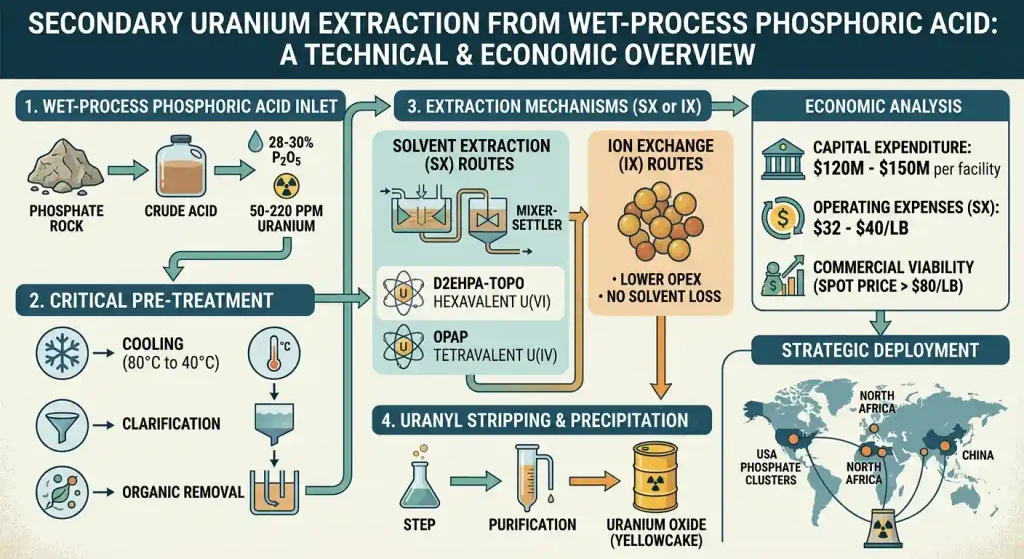
The global transition toward low-carbon baseload energy has intensified scrutiny on conventional uranium supply chains. While primary mining projects face long permitting cycles and geopolitical risks, an alternative resource sits untapped in global agricultural infrastructure. Sedimentary phosphate rock, processed worldwide for agricultural fertilizers, contains naturally occurring uranium concentrations ranging from 50 to 220 parts per million.
When phosphate rock is converted into wet-process phosphoric acid, roughly 80 percent to 95 percent of this latent uranium dissolves directly into the crude acid stream. Globally, over 200 million metric tons of phosphate rock are processed annually into wet-process phosphoric acid, carrying tens of thousands of metric tons of unrecovered uranium oxide directly into synthetic fertilizer supply chains.
The Chemistry of Wet-Process Extraction
Extracting uranium oxide from wet-process phosphoric acid relies on hydrometallurgical solvent extraction or advanced ion-exchange systems. In crude phosphoric acid streams, uranium exists in two distinct oxidation states, tetravalent and hexavalent. Solvent extraction systems require strict oxidation state control to maximize distribution coefficients across liquid phases.
The industrial solvent extraction process generally follows three chemical pathways. The first pathway utilizes di-2-ethylhexyl phosphoric acid combined with trioctylphosphine oxide, which selectively targets hexavalent uranium at an average extraction efficiency exceeding 90 percent. The second pathway employs octylphenyl acid phosphate to extract tetravalent uranium directly without requiring upstream oxidation steps. The third pathway uses synergistic organophosphorus mixtures designed to maximize recovery while reducing solvent degradation from residual humic organic matter in crude acid.
The process demands significant pre-treatment. Crude phosphoric acid containing 28 percent to 30 percent phosphorus pentoxide must be cooled from reaction temperatures of 80 degrees Celsius down to 40 degrees Celsius, clarified to eliminate suspended solids below 50 parts per million, and treated for organic contaminants that cause solvent emulsion or physical phase loss.
Operational Costs and Capital Requirements
The economic viability of secondary recovery depends heavily on global yellowcake market pricing. Historical operations in North America and Western Europe during the late twentieth century supplied millions of pounds of uranium oxide, but shut down when spot uranium prices collapsed below 15 dollars per pound in the 1990s.
Recent cost modelling indicates a structural shift in economic feasibility. Capital expenditure for a greenfield solvent extraction facility co-located at an active 870,000-ton phosphorus pentoxide annual capacity fertilizer complex ranges between 120 million and 150 million dollars. Operating expenses for solvent extraction sit between 32 and 40 dollars per pound of recovered uranium oxide, while total levelized costs, including capital depreciation, average 59 to 83 dollars per pound. Emerging solid-phase ion-exchange resins aim to lower operating expenses into the range of 20 to 25 dollars per pound by eliminating liquid-liquid solvent losses and reducing chemical pre-treatment stages.
At sustained spot prices above 80 dollars per pound of uranium oxide, secondary extraction becomes commercially self-sustaining. This allows major agricultural processing nations to monetize a waste stream while providing domestic nuclear power programs with a secure secondary fuel reserve.
Recent Industrial Advances and Strategic Deployment
Recent developments across international research institutions and resource ministries have brought secondary uranium extraction back into the commercial spotlight. In May 2026, researchers at the Philippine Nuclear Research Institute successfully produced uranium yellowcake directly from wet phosphoric acid streams using advanced mixer-settler extraction systems. This demonstration highlighted how mid-tier agricultural economies can build nuclear fuel self-sufficiency without operating primary mines.
Concurrently, sovereign resource updates from Middle Eastern energy authorities in late 2026 underscored the role of unconventional extraction. Technical assessments revealed that domestic phosphoric acid processing facilities in Saudi Arabia possess the latent capacity to yield hundreds of metric tons of natural uranium annually to support new baseload grid builds.
Furthermore, processing breakthroughs developed at Oak Ridge National Laboratory have introduced integrated, multi-stream recovery systems. Rather than targeting uranium in isolation, these unified chemical workflows allow operators to extract heavy rare earth elements, industrial gypsum, purified phosphoric acid, and uranium oxide from a single processing run. This multi-product yield dramatically improves facility economics and lowers financial barriers to entry.
Strategic Value and Global Resource Capacity
The geopolitical distribution of phosphate reserves creates a unique intersection between global food security and energy sovereignty. Over 70 percent of global sedimentary phosphate reserves are concentrated in North Africa, led by Morocco and Tunisia, alongside major processing operations in China, the United States, and Saudi Arabia.
Recovering uranium from wet-process phosphoric acid offers several structural advantages over traditional open-pit or in-situ leach mining. First, there is zero additional land disturbance, as mining and ore grinding costs are entirely borne by the primary fertilizer manufacturing process. Second, radiological contamination in commercial agricultural products is substantially reduced by removing heavy radioisotopes prior to fertilizer synthesis. Finally, processing operations benefit from immediate integration into existing chemical complexes equipped with bulk acid handling and waste treatment infrastructure.
As regional energy grids seek reliable, non-fossil baseload power, secondary recovery from wet-process phosphoric acid provides a resilient bridge to secure nuclear fuel supplies independent of traditional mining bottlenecks.
References
Chemical studies on uranium extraction from concentrated wet process phosphoric acid, Journal of Radioanalytical and Nuclear Chemistry, 2013.
Evaluation of Potential Uranium Supply from Phosphoric Acid Production, U.S. Department of Energy OSTI Report, 2016.
Recovery of Uranium from Wet-Process Phosphoric Acid by Solvent Extraction: A Review, Industrial and Engineering Chemistry Research, 2014.
Uranium Recovery from Phosphate Rock: Industrial Practice and Economic Assessment, International Atomic Energy Agency Technical Report Series, 2010.
Uranium Resources Associated with Phosphoric Acid Production, Frontiers in Earth Science, 2024.
DOST-PNRI Researchers Produce Uranium Yellowcake from Fertilizer By-Product, Philippine Nuclear Research Institute Bulletin, May 2026.
Saudi Arabia Touts Mineralized Uranium and Unconventional Recovery Pathways, The Northern Miner, September 2026.
Recovery of Rare Earths, Uranium, Gypsum, and Phosphoric Acid, Oak Ridge National Laboratory Technology Transfer Documentation, 2026.