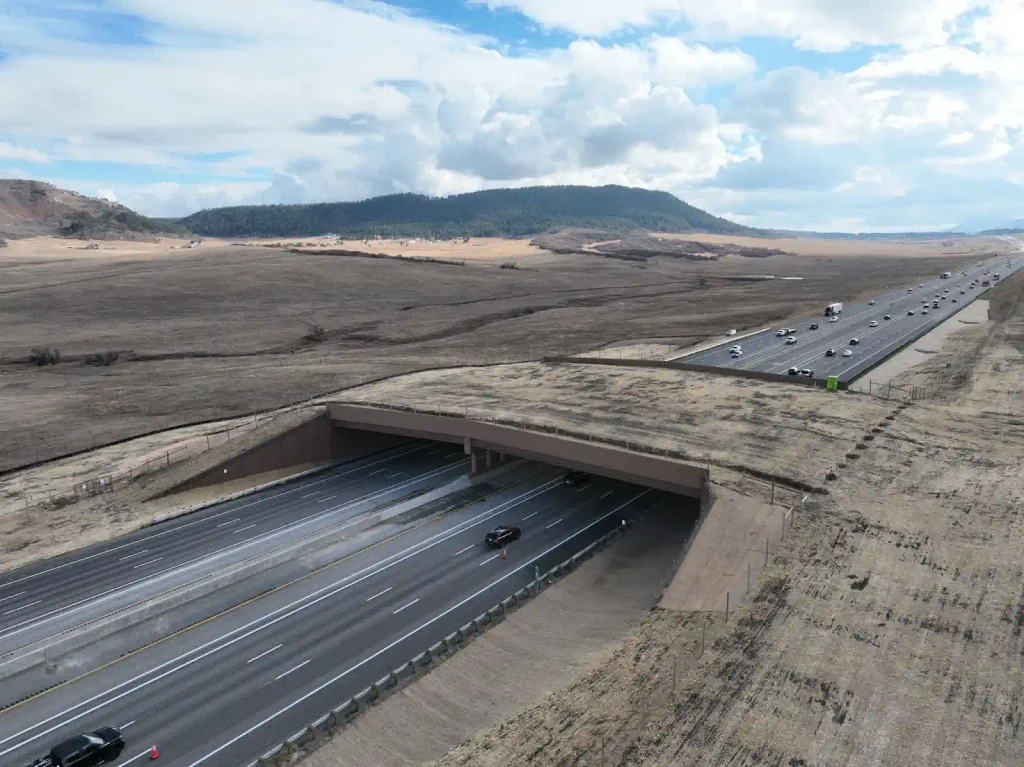
The Highway Barrier and the Greenland Corridor
For decades, the eighteen-mile stretch of Interstate 25 connecting Castle Rock and Monument, Colorado, represented one of the most hazardous vehicle-wildlife conflict zones along the Front Range. Bisecting the largest protected contiguous open space between Fort Collins and Pueblo, a critical migration corridor for elk, mule deer, pronghorn, and black bears, the six-lane interstate carried over one hundred thousand vehicles daily while cutting directly through native winter range.
Prior to targeted mitigation, state transportation records indicated that drivers struck an average of at least one large mammal every day along the corridor during peak summer and autumn migration periods. Beyond the ecological cost, these wildlife-vehicle collisions created substantial public safety hazards and millions of dollars in property damage, emergency response fees, and highway closures annually. To resolve this persistent safety and conservation challenge, the Colorado Department of Transportation and Colorado Parks and Wildlife partnered with federal and county agencies to design a comprehensive crossing network. The centerpiece of this multi-agency initiative was the Greenland Wildlife Overpass, a fifteen million dollar dedicated structure constructed near Mile Point 165.4 in Douglas County.
Infrastructure, Design, and Engineering
Completed in December 2025 ahead of schedule and under budget, the Greenland Overpass is currently recognized as the largest dedicated wildlife bridge in North America. Measuring 200 feet wide by 209 feet long, the structure spans all six lanes of Interstate 25, creating roughly an acre of contiguous natural habitat elevated above highway traffic.
The engineering parameters of the crossing were strictly tailored to the behavioral biology of native ungulates. Species like elk and pronghorn are hesitant to enter enclosed spaces. The 200-foot-wide deck provides clear sightlines across the highway, mirroring open meadow topography. The edges of the bridge feature sound-dampening earthen berms and vegetated side barriers designed to block headlight glare and attenuate engine noise from the traffic below.
The overpass does not operate in isolation; it bridges a critical gap within an interconnected system featuring five wildlife underpasses and over twenty miles of eight-foot-high directional fencing. The fencing prevents animals from entering the roadway while guiding them toward the overpass or underpass portals. Beyond large mammals, the overpass deck was covered with native soil and seeded with regional grasses, shrubs, and flora, creating a functional habitat for non-listed reptiles, amphibians, rodents, and sensitive species such as the Preble’s meadow jumping mouse and northern leopard frog.
Data and Ten-Month Evaluation Metrics
In October 2026, ten months after the structure became fully operational, joint evaluation data released by state officials confirmed a dramatic reduction in wildlife-vehicle incidents. Prior to construction, vehicles hit roughly one animal per day in the area. In the ten months following completion, reported collisions dropped to just two total incidents, marking a ninety-one percent reduction. Game cameras installed along the bridge deck and approach funnels recorded rapid adaptation across multiple species. Wildlife biologists highlighted that female elk leading calves across the overpass occurred within the first few months of opening, a key indicator that regional herds have accepted the bridge as a natural migration path.
Economic Return on Investment
While the initial capital expenditure for the Greenland Overpass totaled fifteen million dollars, funded primarily through federal grant awards alongside state contributions, the financial return through accident avoidance is substantial. According to transportation safety cost models, the average cost of a deer-vehicle collision is estimated at nineteen thousand dollars. An elk-vehicle collision averages seventy-three thousand dollars in total economic damages, while a moose collision averages one hundred ten thousand dollars. By reducing corridor collisions from roughly three hundred per year down to single digits, the system prevents millions of dollars in annual personal injury and property damage claims. Based on these savings, state planners estimate that the infrastructure asset will pay for itself entirely within two to three years of operation.
A Blueprint for Future Infrastructure
The success of the Greenland Wildlife Overpass demonstrates how integrating biological data into civil engineering projects yields immediate public safety and ecological benefits. As transportation departments across the country evaluate wildlife crossing grants allocated under federal infrastructure frameworks, Colorado’s Front Range project provides a clear empirical model for reconciling high-density highway corridors with natural wildlife migration routes.